Silkies For Sale
Understanding Partridge Silkies at VJP Poultry
 The partridge color and pen is new to VJP Poultry this year. Many people ask whether the partridge is a different bird than the silkie. No, partridge is another color variety like a white or a black. It is still the same fluffy silkie breed.
Partridges start out as chipmunk striped chicks. The background color can be light or dark. The stripes are either brown or black. The stripes occur on the back and on the face of the chick. These stripes are deceiving because the partridge chick will not grow up to show these same markings as an adult.
Sometimes the partridge chicks will not hatch out with chipmunk stripes at all. You could get a solid buff or black color even with both parents being Partridge.
The adult male and female can look very different from each other. Males tend to be a brighter color and the females a duller color. The standard calls for a red head on both the male and female. The male should have a dark chest and a dark tail. Red can overlay on the heck (hackles ) and back (saddle). The females are described as a reddish bay color. They should have a dark undercoat with a light buff or red on top. Chestnut color with penciling.
In order to hatch out the correct color chicks for showing partridges you need two different breeding pens. Darker colored roosters will be needed to hatch out correct looking males. Roosters that are redder and have less black are better for hatching out correct females. This is also called a double mating system where one pen is used for breeding males and another pen is used for breeding females.
Occasionally one of your color pens which are not partridge will produce a partridge chick. For example your all black pen will suddenly hatch out chipmunk striped hatchlings. If you know that your blacks or your whites occasionally produce partridge you may want to use these colors as out crosses for your partridge flock. Experiment and watch what they produce. If it improves the line, keep it in. If it doesn’t then remove those birds.
You may also hear talk of blue partridges. A blue partridge has a blue background instead of black. They hatch out with chipmunk stripes but instead of a black chest and tail, it is dilute or blue.
I will call something a light partridge if it looks mostly buff colored but came from the partridge pen. I will call it a dark partridge if it looks solid black when it is hatched out but , again, came from the partridge pen. I will call it a standard partridge if it is born with the full chipmunk striping.
Partridge can be a confusing variety especially to show. There is one set of standards for the males and another for the females. This is the only variety that is like that in the silkie breed. It is definitely a challenge to show it with the correct coloring and to breed it. They are, however, beautiful birds and are a wonderful, colorful addition to your backyard flock.
For tips and tricks for raising outstanding silkies check out our Chicken Learning Center at VJPPoultry.com . VJP Poultry is an NPIP and state inspected hatchery located 30 miles north of St. Paul. We hatch out silkies all year long so we always have stock available. Like us on Facebook to get weekly updates on what we currently have for sale.
Victoria J. Peterson

Silkies For Sale – 5/12/17
Selective Silkie Breeding
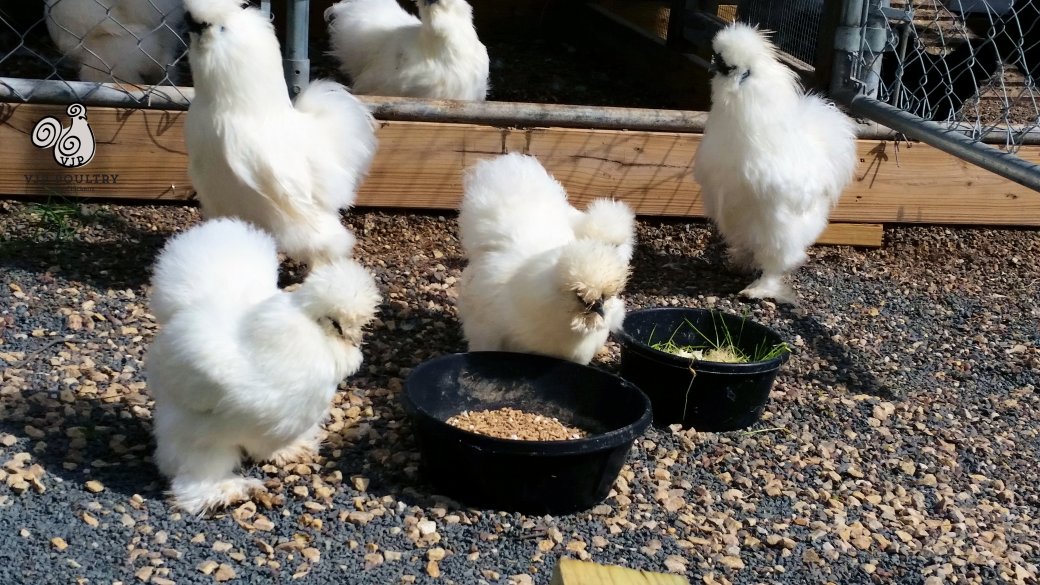 I am often asked why silkies that are hatched out from breeders look so different from silkies that come from large hatcheries. The short answer is that serious silkie breeders take care to improve their silkies by breeding to fix good traits and eliminating bad ones as they set up their breeding pens.
In nature, jungle fowl used natural selection when choosing their mates. Males that were strong and vigorous had a large following of female hens. These strong genes were passed along to their descendants. Weaker males were not selected as worthy mates by the females.
After domestication occurred, the farmer used artificial selection to improve his flock. Single mating is taking one outstanding female and one outstanding male and breeding them. Their offspring should be perfect. Right? Not always. There is no such thing as a perfect bird. Other methods are needed.
First, the breeder needs a plan. They need to have specific goals. Is there something that needs to be improved? Those would be things like, type, feather color, skin color or feather quality. Maybe your breeding goal is to get rid of something such as extra claws or toenails.
Most breeders start with a good set of birds that are excellent examples to begin with. They can breed with those birds for many years provided they keep the best and sell or cull the rest. The best must also be the most vigorous and healthy. By constantly improving your flock by keeping the best and the most vigorous and only breeding with those, you can continue to breed for many years without going outside of your own flock.
Line breeding is one way to keep up the health of your flock but still keep it closed to other birds. Introducing new birds and breeding with them can bring recessive gene traits to the fore front and you can be bringing in unwanted traits that will be difficult to later breed out.
Line breeding involves pairing fathers with daughters and sons with mothers. Take it a step further and breed Grandfathers with granddaughters and grandmothers with grandsons. You do not want to breed brother to sister if you can help it as that is a very close shared gene pool. Excessive inbreeding can cause infertility, severe deformities, and lethal genes but it can also produce some spectacular birds.
Every seven years or so, you can then out cross to bring in some fresh blood lines. It is best to go back to your original breeder to get these out cross birds. They will have the same line or strain as you do and you will encounter less surprises in your offspring.
Line breeding and Spiral breeding are two methods for continuing to breed healthy birds without resorting to too much out crossing of new blood. With silkies it is important to keep your colors separated, especially if you are breeding with thoughts of showing in a poultry show later.
Most people do backyard breeding for fun and get all kinds of interesting combinations, but if you are serious about wanting to improve the breed, then work hard at striving to meet the Standard of Perfection. These standards can be found online for every breed of chicken and are very worthwhile reading. Good luck in your breeding endeavors.
For tips and tricks for raising outstanding silkies check out our Chicken Learning Center at VJPPoultry.com . VJP Poultry is an NPIP and state inspected hatchery located 30 miles north of St. Paul. We hatch out silkies all year long so we always have stock available. Like us on Facebook to get weekly updates on what we currently have for sale.
Victoria J. Peterson


 VJP Poultry