Silkies For Sale

Medicated Chick Starter, Coccidiosis and Summer

20160307_181446One question I am often asked at VJP Poultry is whether someone should use medicated chick starter feed or unmedicated chick starter feed. This is a hot topic on the internet with many people weighing in on one side or the other. There is good evidence on both sides of the issue.

When ever the weather becomes hot and humid and we get several days of steady rainfall I am on the lookout for Coccidiosis or Cocci as it is called for short. Coccidiosis is one of the most common chicken diseases. There are at least seven or more strains of it known to effect chickens.

Coccidiousis is an intestinal disease caused by parasites.  These parasites are called coccidia oocysts.  They live in the soil but can be carried by equipment, people or other birds, especially wild birds.  Once chickens eat these parasites, they reproduce in the chicken’s intestinal tract.  When the amount of parasites reaches a high enough level, the chicken becomes sick.  The infection damages the lining of the birds digestive tract.

Birds that have coccidiosis often have a change in their droppings, with blood, mucous and diarrhea present.  The birds will appear hunched with ruffled feathers.  If not treated, death is possible.

Baby chicks are most susceptible to death because their immune system is still developing.  It is one of the leading causes of death in chicks.

Once the chickens have recovered from the infection, they build immunity to that specific strain and are less likely to get sick again.  Humans can not catch coccidiosis from their chickens.

If you suspect that your chicks or adults have cocci, you need to do a 5 day treatment with Corid or Sulmet.  Treat the entire flock by adding it to the water.  Corid is super concentrated Amprollium.  Amprollium is a drug that blocks Thiamine uptake, thereby preventing the carbohydrate synthesis necessary for cocci to grow.  It is not an antibiotic.

Amprollium is a coccidiostat formulated to reduce the growth of the oocyts, allowing the young chick to develop an immunity to Cocci as they grow into adulthood. Chicks that are feed a cocciodiostat  are more able to fight off the oocyts  in the enviroment.  This is because the preventative in the feed can then slow the growth of the oocyts while the chicks develop their own immunity.

Most medicated chick starter feed contain the medication Amprollium.  Amprollium does not “treat” coccidiosis but it helps babies fight off cocci oocysts while they develop their own immunity.   It is a preventative.

If your birds have been vaccinated against coccidiosis, feeding them medicated feed will nullify the coccisiosis  vaccination.

Medicated starter is not meant to be fed to laying hens, even if they become ill with coccidiosis.  Adult hens on medicated feed may transmit some of the medication via their eggs and it would not be wise to eat those eggs.

Chicks do not need medicated feed but some people prefer it as kind of insurance.  If you don’t use it the chick’s environment needs to stay extra clean.  Coccidia  oocysts multiply in wet environments.

For the first four weeks of a chicks life medicated feed will protect them.   Medicated feed after the eighth week will actually prevent the chicks from developing their own immunity and it should be stopped.

I feel that weather has a huge impact on when cocci can strike.  Every summer there is that time period of hot, humid weather which results in steady rainfall over several days.  That is when Cocci is most likely to strike.  I watch the poo for signs of blood and if I see any, then I treat with the Corid for five days.

I use medicated chick starter in the summer from June until the end of August. Then I switch  back to unmedicated chick starter feed the rest of the year. I only have seen Cocci in the summer so I don’t use it when I don’t need it.  Don’t mix the two feeds together. You will not receive the correct treatment level if you do so.

My advice is to always keep Corid on hand in case you need it.  Chickens can be sick with Cocci without showing the symptoms of blood in the poo. When in doubt, treat first with Corid.  Once you can rule out Cocci, then it will be easier to diagnose other issues.

For tips and tricks for raising outstanding silkies check out our Chicken Learning Center at VJPPoultry.com .  VJP Poultry is an NPIP and state inspected hatchery located 30 miles north of St. Paul.  We hatch out silkies all year long so we always have stock available.  Like us on Facebook to get weekly updates on what we currently have for sale.

Victoria J. Peterson

20160526_102233


Silkies For Sale – 5/28/17

Trimming Your Silkie’s Toenails

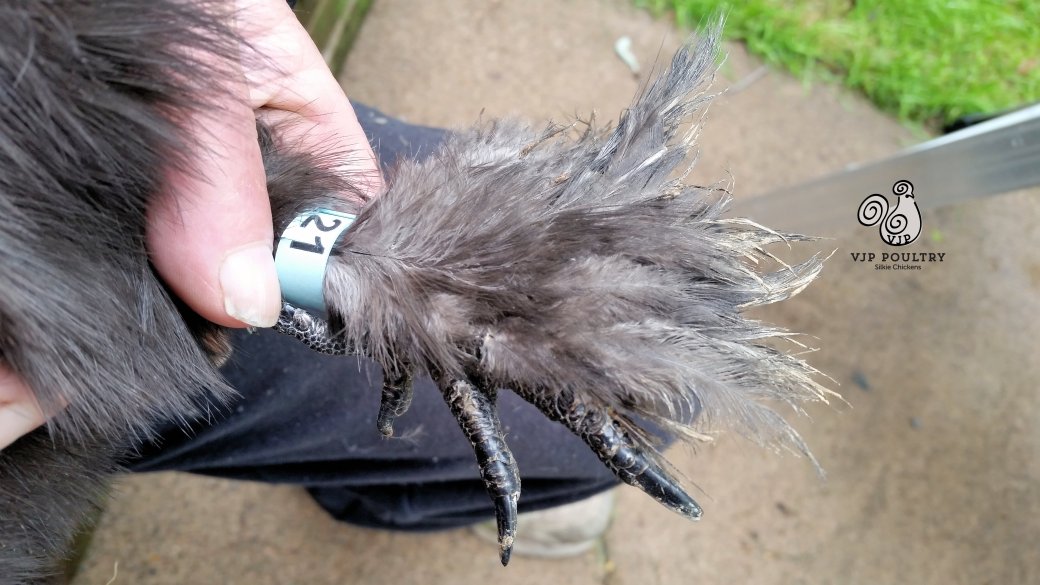
20170521_140032     This is a task that most people don’t think about when they become chicken owners. It might be a little overwhelming or scary to think about trimming your silkie’s toenails but with a little practice you will soon see it as a normal part of your chicken’s maintenance and well being.

Long overgrown nails do occur  and it is a good idea to trim them before they get too long so that your bird can walk without difficulty. In most cases they wear down on their own. The act of scratching naturally wears down the nails of a chicken. Overgrown nails are not normally a problem in most flocks with access to natural ground.  Silkies, however, are not known for free ranging very far away and they tend to go broody. When broody, hens will sit on the nest for long periods of time and their nails will not become worn down.  A nail that expands below the toe and is beginning to curl needs to be trimmed.

Pick a day and do all of your birds at once so that you don’t have to keep track of who has had them done and who has not.  This is really a two person job, so find someone who can help you out by holding the bird as you trim.

We set up an old ironing board in a sunny spot to rest our equipment on. I have a printed list of all of the silkies and their numbers and I check them off as we complete them.  I hold the bird and my husband, Dennis, does the trimming.

I block the birds in their coop or in their runs to make it easier to catch them.  After we are finished I release them to a different section or into the yard so I don’t end up catching them twice.

Before trimming the nail, you will want to remove  all of the built up mud and poo that is sticking to the nails and bottom pads of the feet.  Sometimes these can look like balls of mud at the tips of their toes.

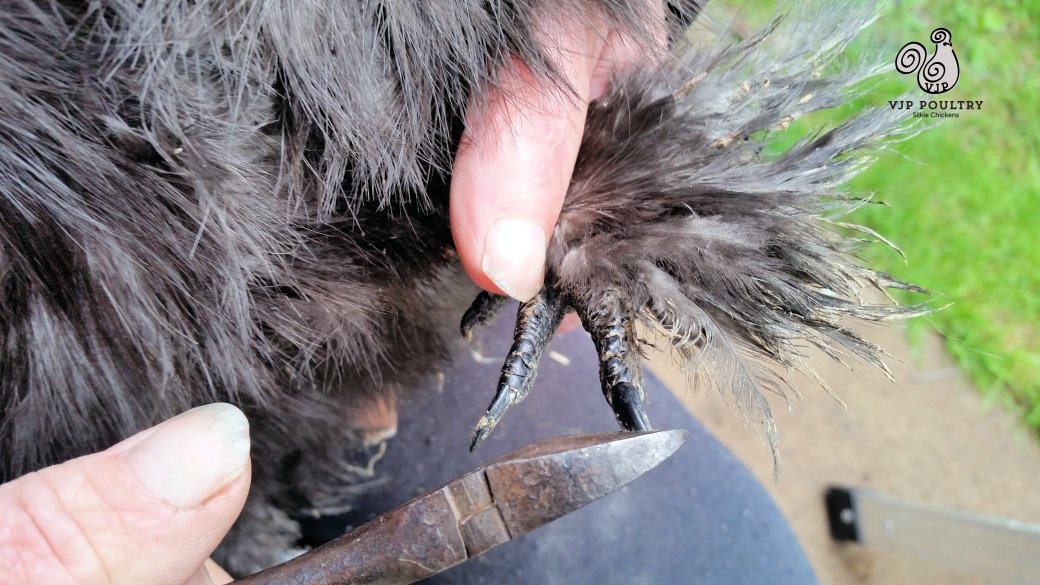
You can use toenail trimmers designed for dogs or a pair of diagonal wire cutters. Your clippers simply need to be large enough to fit around your chicken’s nail so it can be easily snipped off.

The most important thing is to avoid cutting the vein in the nail.  It is just like trimming a dog’s toenail.  You will want to stay a quarter inch or so away from the vein.  Trim a small amount of the nail off at a time.  The nails don’t have to be short, they just need to allow for the bird to naturally stand or move about.

The “quick” is a small blood vessel that supplies blood to the nail.  It is inside of the nail shaft. It can be seen as a small, pink line inside the clear nail.  Sometimes it is hard to see in younger birds but it is very clear in older silkies.  If the quick is cut, the nail will begin to bleed.  Don’t panic. The silkie will not bleed to death. Stop the bleeding with styptic powder or a styptic pencil used in shaving. You can also use flour or cornstarch.  You can also use a tissue and apply pressure to the spot that is bleeding.

This is also a good time to trim a rooster’s spurs.  They continue to grow if not trimmed and can interfere with the rooster’s ability to walk.  Us the same method as for trimming the toenails.  Blunted spurs are safer for hens, humans and other roosters.

Keeping the nails of roosters trimmed is especially important.  His sharp nails can injure the hens when he mounts them and can leave gashes.

If your birds are held often and cuddled it will be easier for you to learn to do this task yourself. The silkies will be more cooperative and it is almost as if you were giving them a manicure and spa treatment. They are very lucky birds to be cared for so well.

For tips and tricks for raising outstanding silkies check out our Chicken Learning Center at VJPPoultry.com .  VJP Poultry is an NPIP and state inspected hatchery located 30 miles north of St. Paul.  We hatch out silkies all year long so we always have stock available.  Like us on Facebook to get weekly updates on what we currently have for sale.

Victoria J. Peterson
20170521_140009

Silkies For Sale – 5/19/17

Understanding Partridge Silkies at VJP Poultry

20161116_133942     The partridge color and pen is new to VJP Poultry this year. Many people ask whether the partridge is a different bird than the silkie. No, partridge is another color variety like a white or a black.  It is still the same fluffy silkie breed.

Partridges start out as chipmunk striped chicks. The background color can be light or dark.  The stripes are either brown or black. The stripes occur on the back and on the face of the chick.  These stripes are deceiving because the partridge chick will not grow up to show these same markings as an adult.

Sometimes the partridge chicks will not hatch out with chipmunk stripes at all. You could get a solid buff or black color even with both parents being Partridge.

The adult male and female can look very different from each other.  Males tend to be a brighter color and the females a duller color.  The standard calls for a red head on both the male and female. The male should have a dark chest and a dark tail.  Red can overlay on the heck (hackles ) and back (saddle).  The females are described as a reddish bay color. They should have a dark undercoat with a light buff or red on top.  Chestnut color with penciling.

In order to hatch out the correct color chicks for showing partridges you need two different breeding pens.  Darker colored roosters will be needed to hatch out correct looking males.  Roosters that are redder and have less black are better for hatching out correct females.  This is also called a double mating system where one pen is used for breeding males and another pen is used for breeding females.

Occasionally one of your color pens which are not partridge will produce a partridge chick.  For example your all black pen will suddenly hatch out chipmunk striped hatchlings.  If you know that your blacks or your whites occasionally produce partridge you may want to use these colors as out crosses for your partridge flock.  Experiment and watch what they produce. If it improves the line, keep it in.  If it doesn’t then remove those birds.

You may also hear talk of blue partridges.  A blue partridge has a blue background instead of black.  They hatch out with chipmunk stripes but instead of a black chest and tail, it is dilute or blue.

I will call something a light partridge if it looks mostly buff colored but came from the partridge pen.  I will call it a dark partridge if it looks solid black when it is hatched out but , again, came from the partridge pen.  I will call it a standard partridge if it is born with the full chipmunk striping.

Partridge can be a confusing variety especially to show.  There is one set of standards for the males and another for the females.  This is the only variety that is like that in the silkie breed.  It is definitely a challenge to show it with the correct coloring and to breed it.  They are, however, beautiful birds and are a wonderful, colorful addition to your backyard flock.

For tips and tricks for raising outstanding silkies check out our Chicken Learning Center at VJPPoultry.com .  VJP Poultry is an NPIP and state inspected hatchery located 30 miles north of St. Paul.  We hatch out silkies all year long so we always have stock available.  Like us on Facebook to get weekly updates on what we currently have for sale.

Victoria J. Peterson


20161116_135514