Tag: Silkies for sale in MPLS
How We Incubate Our Eggs at VJP Poultry – 3/14/17
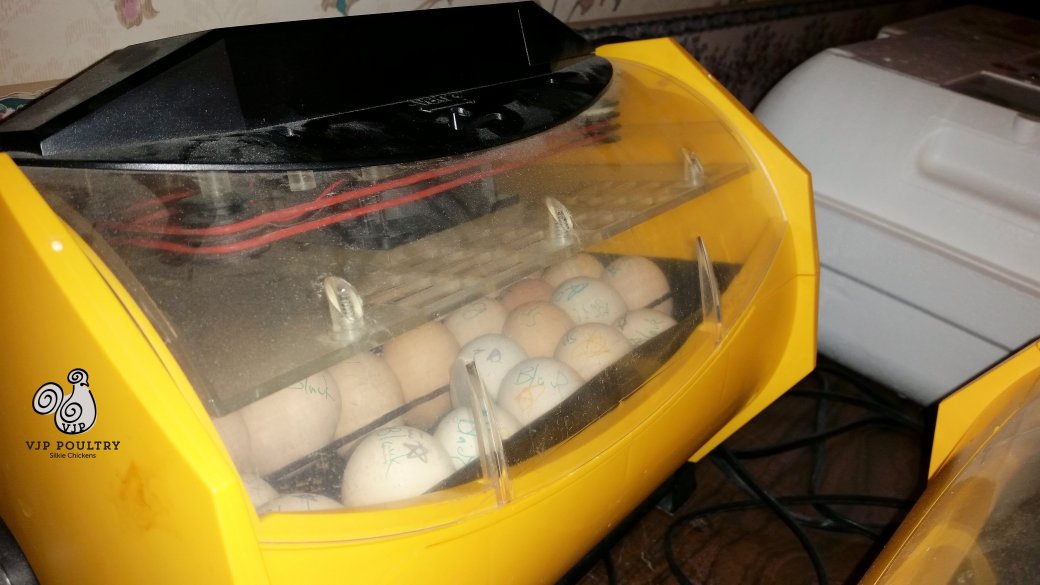 In a previous blog we discussed how to improve the hatchability of an egg before it begins to incubate. In this second part, we will discuss how to improve your chances of having the egg hatch after it arrives in the incubator.
Your stored eggs should have been resting in a cool, dry spot. I actually tip the egg carton in which I am storing the eggs each day . I remove the eggs from the cool area about 6 hours before I place them in the incubator so that they can gradually warm up to room temperature. If you put cool eggs into a warm incubator, the eggs will sweat and condense water.
Your incubator should have been turned on 24 hours prior to your putting eggs in it. I have thermometers to test the temperature before and later after I put the eggs in. Still air incubators are set a a slightly higher temp than circulated air incubators. I have circulated air and I keep the temp at 99.5 degrees. Check the temp at different spots in the incubator. You may find temperature differences at the corners and sides and also in the middle. I keep water in the troughs at the bottom of the incubator. Sometimes I will weigh and record the weight of each egg in grams using a scale. I then weigh the eggs again at 7 days, 14 days and 18 days. If your humidity is correct you should note a drop of around 2 grams at each weighing. If they are not losing enough weight then your humidity is too high. If they are losing too much weight, then you will need to increase the humidity in your incubator.
Try to fill the entire incubator with eggs. The heat will be more evenly distributed that way. Make sure that the automatic turners are working and moving. If you are self turning the eggs, I set a timer on my phone to remind myself to turn the eggs every four hours.
I candle my eggs at day 7 and remove all of the eggs that don’t show veining or that have a single blood ring around the middle of the egg. These eggs will not hatch. I use a small, strong LED flashlight to candle.
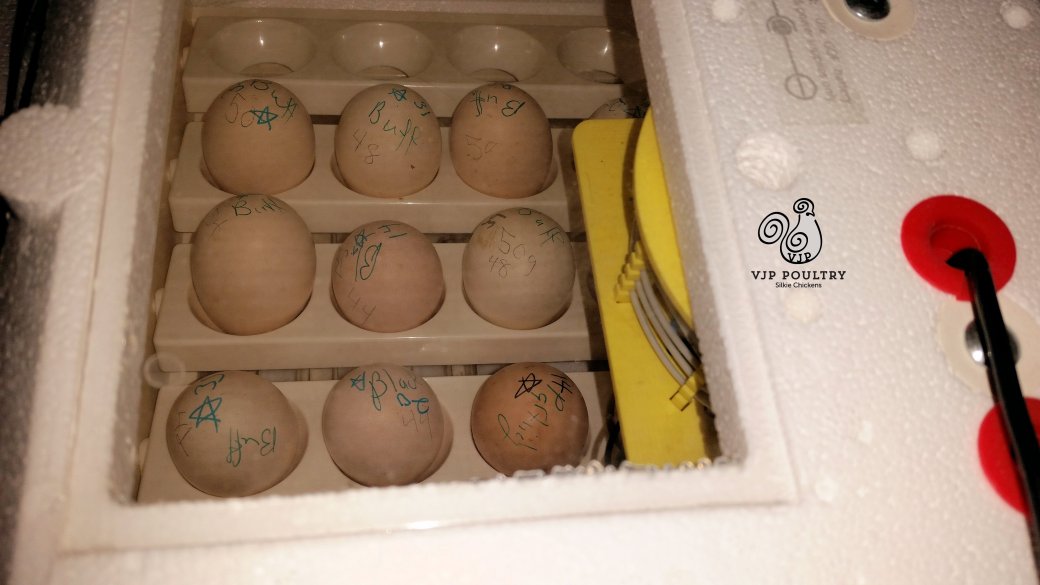
I use one incubator for incubating the first 17 days and another as a hatcher for days 18-21. When I switch to the hatcher, I mark where the air cell is and make an X where the air cell dips the lowest in the egg. When I put them on their sides, I make sure that the X is showing on top of the egg. That is where the chick will probably make its external pip. I make sure that the eggs are spaced out and not touching if I can help it. I like the fat end facing me so that I can see pipping progress easier. I also like to leave a space where I can add water when I need to without disturbing the eggs. They need two days on their sides so that they can get into position for pipping and zipping.
I use Brinsea octagons for hatching. Brinsea is no longer making that model. Their new Brinsea incubator is the Ovation 28 Eco. I keep track of what my fertility rate is and what my hatching rate is. I also open up any unhatched eggs to see what went wrong and try to improve next time.
I hope these suggestions were useful to you. What works for one person may not work for another. The climate you live in will also effect the humidity and the ability for your eggs to hatch. Good luck on all your future hatches from VJP Poultry!
For tips and tricks for raising outstanding silkies check out our Chicken Learning Center at VJPPoultry.com . VJP Poultry is an NPIP and state inspected hatchery located 30 miles north of St. Paul. We hatch out silkies all year long so we always have stock available. Like us on Facebook to get weekly updates on what we currently have for sale.
Victoria J. Peterson
Silkies For Sale – 3/10/17
How To Sex Young Silkie Chickens at VJP Poultry – 3/7/17
 Silkies have always been known as a breed of chicken that is extremely difficult to sex. Most people will tell you that you won’t know the sex of your silkie until it either crows or lays an egg. I am going to give you some helpful hints and tricks to improve your chances of getting the sex of silkie chick that you desire.
Lets start with looking at physical appearance in newborn chicks. A boy may be slightly bigger than a girl chick. It will have thicker, more sturdy legs than a female. Remember that you need to judge each by its own color. My buffs are always bigger than my other colors. You can’t judge a buff against a white for size for example. You need to judge them within their own color group and within their own hatch mates.
A male chick will be more curious and outgoing than a female. If you put your finger into the brooder, the males will tend to peck at it more than the females will. A males will just have a more tough guy look to it and will be more likely to look you in the eye.
At ages two to four weeks, behavior will still be a good indicator. I notice that when taking pictures the boys tend to stand in the front, between the the unfamiliar camera and the girls in the back of the group. The boys will lift their heads up high and stand up straighter. The females will hunch down lower to the ground. If you make a noise or move your fingers, the boys will be more curious and come closer to you.
At around five weeks, I begin looking at their combs. I notice that the comb tends to be wider on the males and more narrow on the females. The boys will also begin to develop a bump that is circular in the middle of the comb. This bump will become larger as the chick grows. The female’s will stay flat for awhile..
Behavior is still important. Boys will need more room as they start to chest bump the others and hopping around the brooder. Females will chest bump too but it is really more of a boy thing. Males will continue to be more outgoing and curious.
At around twelve weeks the girls will begin to have a slight bump in their comb making it more difficult to tell them apart. Males will begin to develop small red wattles under and on either side of their beaks. The comb begins to look redder in the males.
Obvious boys are easy to tell. It is very apparent that they are males in looks and behavior. Late blooming boys are much harder. They can look like females for a long time and then suddenly develop a male boy type.
Boys will also sound different from girls when you pick them up. Boys will make more of a honking sound which will gradually develop into a crow.
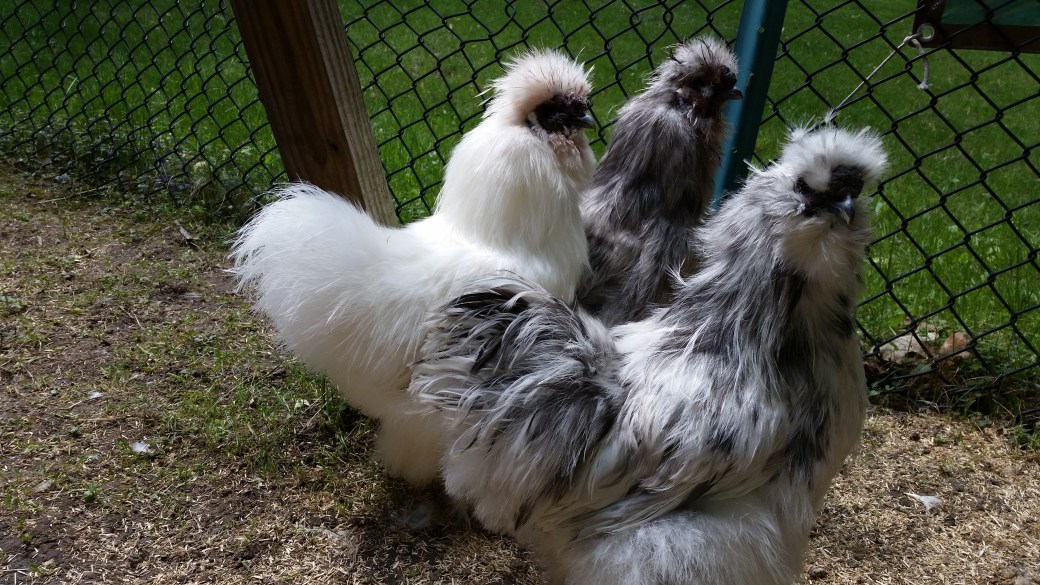
As boys grow and develop their body shape will change and they will begin to grow streamer feathers from the back of their heads. Their combs will become prominent and red wattles will appear. Girls will have a pom pom shape to their crest . They will also sit lower to the ground with boys standing up straighter.
Remember – until an egg is laid, we are guessing as to gender. These guesses are based on observation but nothing is 100% accurate unless you have a DNA test done. These hints should help you make a guess as to what sex your silkie chicks is, but do not be surprised if your little pullet suddenly begins to crow!
For tips and tricks for raising outstanding silkies check out our Chicken Learning Center at VJPPoultry.com . VJP Poultry is an NPIP and state inspected hatchery located 30 miles north of St. Paul. We hatch out silkies all year long so we always have stock available. Like us on Facebook to get weekly updates on what we currently have for sale.
Victoria J. Peterson
 VJP Poultry