Feed and Treats For Adult and Juvenile Chickens.

bestChickens are Omnivores.  They are opportunistic eaters.  They will eat foods of both plant and animal origins.  They love treats and are easy to spoil. What they are fed can make a huge difference in their egg production, reproduction ability and overall lifespan length. It is important that they are given foods that have good nutritional value and are natural for their behaviors as chickens.

When chicks are little they eat Chick Starter as their main source of food.  At around 10  weeks they can begin Grower Feed. This feed is around 16% protein and is designed to sustain growth all the way to maturity. Gamebirds will need a higher protein content such as a Gamebird Conditioner feed.  I feed my silkies Gamebird Conditioner which has a protein content of 20%. If you are raising meat birds they will need their own separate Meat Bird Grower Crumble for fast growing birds. They require a protein content of 20-24%.  The basis of any good chicken diet is a high quality poultry pellet or crumble. Most if not all of its nutritional needs should come from that feed. It is complete and balanced and does not need anything added to it for optimal development of the bird.

Layer feed can be given once the pullets have begun laying eggs. It should not be given before that time as the higher calcium content can cause damage to their kidneys as they are not using the calcium for eggshell development.  Layer feed should not be given to roosters as it can be detrimental to their kidneys as well. Layer feed is designed to provide optimum nutrition for birds laying eggs. It contains 16% protein and increased levels of calcium for proper shell creation. Average laying hens will consume 1/4 pound of feed per day depending on the size of the bird, weather conditions and level of productivity.

Another type of feed is All Flock.  It is designed for adult birds but does not contain the added calcium.  You can feed it to a mixed flock of ducks, geese, turkeys and chickens. When feeding this to laying hens, you will need to offer some Oyster Shell in order for them to get the needed calcium for shell development. Offer it in a separate bowl from regular feed and the hens will eat it as needed.

Scratch is a mix of cracked rolled or whole grains such as corn, barley, oats or wheat.  It is low in protein and does not provide balanced nutrition such as a commercial feed would. However, as the name implies, it is food that is thrown on the ground and the chickens get to scratch around in the dirt for it. Scratching for food is a very natural behavior for chickens and is a good form of exercise for them. Only feed them as much scratch as they can totally consume in 20 minutes.

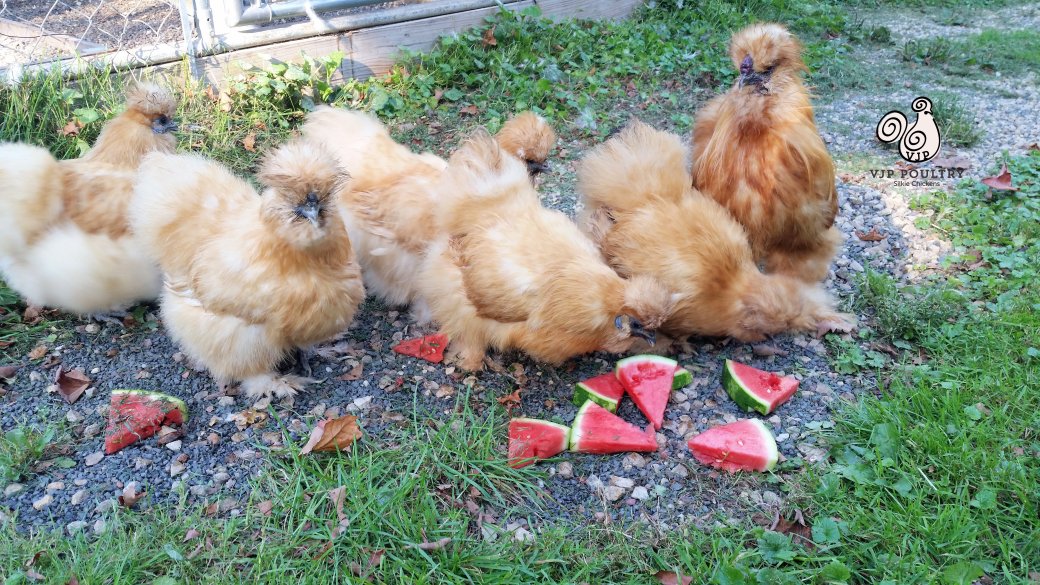
Table scrapes are routinely given to chickens but should be thought of as a treat.  Most food scrapes are fine but some are better than others. Feed bread in moderation as it has little nutritional value. Cat and dog food are sometimes given during molting because of the high protein content. Citrus is usually frowned upon as it may interfere with calcium absorption and cause soft egg shells. Dairy products should be fed in moderation as chickens have a hard time processing large amounts of dairy. No dry beans or uncooked rice.  Watch out for too salty or fatty foods.

Allow your chickens to free range and forage for food when you can.  They love looking for bugs and green plants and the adventure of finding them. Do not feed your chickens grass clipping as this can cause impacted crop. Always provide commercial feed for them. They will not find enough food free ranging in a typical suburban yard.

One way to tame and bond your chicken to you is to occasionally give it some treats.  There are many commercial treats available. Grubblies and Dried Mealwormsare natural insects that have been freeze dried or oven baked.  A poultry Flock Block can be placed in the coop and left for the birds to gradually peck away at it. A poultry Suet Block is made mealworms and sunflower seeds. .  Happy Hens Treats, Kaytee mealworm , and Manna Pro Harvest Delight are all good commercial treats.  As a boredom buster use a treat ball to entertain and provide treats for your chickens.

Too much of a good thing can always be a problem.  Chickens can become obese and develop fatty liver disease. Keep treats down to 20%  or less of their regular diet. Make sure that their commercial feed is always available to them especially before evening. You want to make sure that the chickens go to bed with a full crop which not only keeps them warm but aids in the nightly development of the egg.


For tips and tricks for raising outstanding silkies check out our Chicken Learning Center at VJPPoultry.com .  VJP Poultry is an NPIP and state inspected hatchery located 30 miles north of St. Paul.  We hatch out silkies all year long so we always have stock available.  Like us on Facebook to get weekly updates on what we currently have for sale.

Victoria J. Peterson
20180907_165826


Feed and Treats For Baby Chicks

20180123_140427-1The sooner you start your baby chicks with good nutritional habits the better off they will be their entire lives. Typically we are told that baby chicks don’t need anything to eat or drink for about 48 hours after they are hatched. They will be getting sustained by the yolk of the egg which they absorb into their bodies just before they break through the shell.  This is why they can be sent by post office from hatcheries with nothing to eat or drink in their boxes. Research is now showing that chicks that are given food and water immediately after hatching have a better chance of survival and better growth. Yes, they can survive without food or water for the first few days but it is much better if they are given the opportunity to eat and drink right away.

Chick Starter is the ideal food for baby chick’s first week and should be the sole ration. Feed companies spend lots of time and money researching and preparing mixtures that provide optimum nutrition for growing chicks. Chick starter has sufficient protein, carbohydrates and vitamins to support growth. Chick starter should be given for at least the first six to eight weeks and can actually be given to adult birds as well.  Do not try and mix your own feed at this point as it is crucial that baby newborn chicks  have the nutrients they need to grow.  If you get caught without chick starter when your chicks hatch, you can mash up hard boiled egg yolk with ground up oatmeal as a temporary substitute.  Don’t give treats until they are very familiar with what the chick starter looks like. smells like and tastes like.

There are two types of chick starter, medicated and nonmedicated.  Medicated chick starter comes with medication to prevent coccidiosis, an intestinal disease that interferes with nutrient absorption. If you keep your chicks in a clean brooder and do not let them have contact with adult birds or the ground, they do not need to have the medicated chick starter. If you brood a lot of chicks (over 50) and it is hot and humid outside, then you might consider getting the medicated chick starter.  Do not give them the same food that your adult chickens eat. They need a high protein food which has a protein level of 20%.

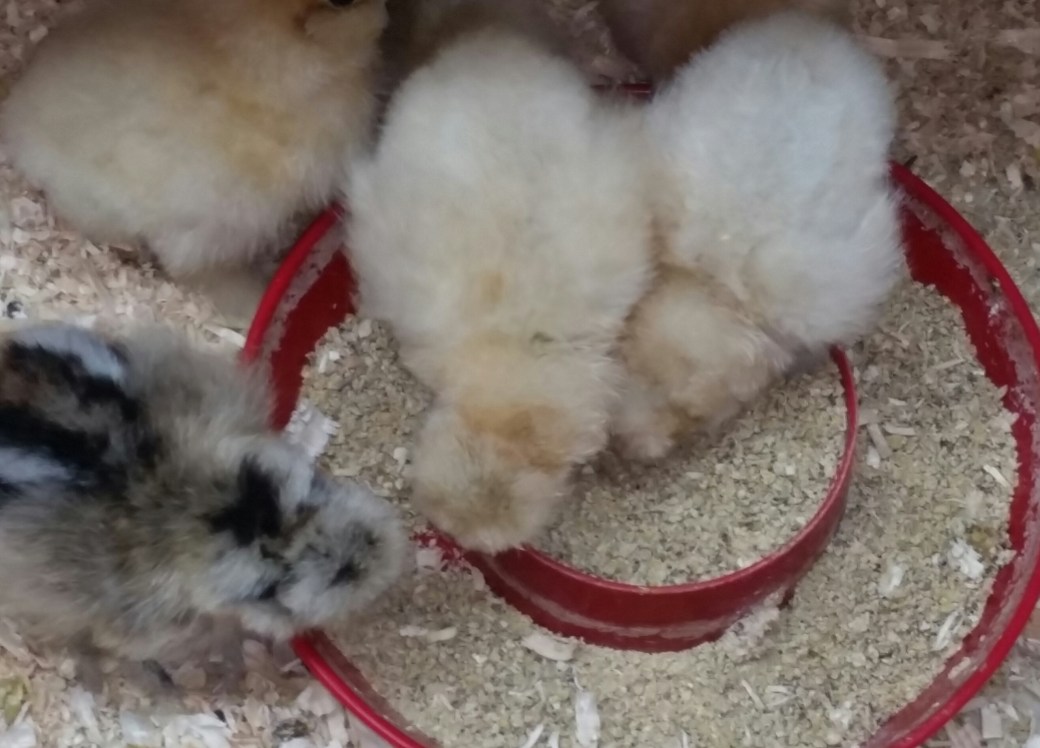
Start by sprinkling chick starter on top of a paper towel in order to encourage pecking at it.  You can then move to a chick feeder. I like to use red colored feeders as the color red stimulates the chick and encourages pecking.  If your chick does not seem to be eating and drinking, dip their beak into the water and then again into the food. If a chick is not eating or drinking it will feel lighter than the other birds.  I also like to grind up the chick starter into smaller particles using a coffee grinder. They seem to like it better when the pieces are smaller.

I also add vitamins, probiotics and electrolytes to the newborn chick’s water. Rooster Booster  is a great product for these additives.  I also had a little apple cider vinegar (with the mother) to their water for overall good health.

When you are ready to add treats to your chicks diet, make sure that they are healthy treats. Good examples would be foods like fruits and vegetables, high protein, whole grains, low sugar, and low salt products.  If chicks are given anything besides chick starter, they will need grit (sand) to aid in digestion.  Chick starter is digested by saliva but other foods require grit for grinding in the gizzard since the chicks do not have teeth.

At this age they should have chick grit, not adult grit which would be too large for them. Sprinkle the sand on top of their food as if you were sprinkling salt on something. Do not place it in a separate dish but put it right on the food to make sure that they are getting some.  Grit is not the same thing as Oyster Shell. They should not be given oyster shell at all as too much calcium will cause organ failure.

The first treats that I give are mashed hard boiled egg yolk and ground oatmeal. I grind the oatmeal in a coffee grinder.  It will almost look like powder.  After that I might move on to sweet corn. I grind that up in a food processor.  Whatever you give to them must be in small pieces. I also like to take  carrots and grind them up in the food processor. Leafy greens must be very processed and in tiny pieces. You do not want the chick to develop crop issues.

Some people like to give unflavored yogurt to chicks. I have found it to be very messy and being a dairy product, I would not give them too much of it. It can cause stomach upset. Probiotics are a good choice for gut health instead.

Older chicks can be given Chick Sticks or mealworms for a treat.  You can also begin giving scraps from your dinner table as long as the pieces are small and grit is sprinkled on top.

When chicks eat treats they are not eating commercial feed which should be their main source of nourishment. Treats should only be 5-10% of a chick’s diet. Anything that you add to their diets can dilute the nutrient balance of the commercial feed. Even healthy snacks should be given in moderation. A chick’s growth and immune system can be affected by too many treats which can create an imbalance in nutrients.

When chicks are around eight weeks old they can move on to Grower feed. Start by mixing the two together 50% chick starter and 50% grower feed. Don’t save your chick starter for the next time you have chicks. It will grow moldy and be harmful for the chicks. Use it all up. It is ok for them to be eating it at any stage of development.


For tips and tricks for raising outstanding silkies check out our Chicken Learning Center at VJPPoultry.com .  VJP Poultry is an NPIP and state inspected hatchery located 30 miles north of St. Paul.  We hatch out silkies all year long so we always have stock available.  Like us on Facebook to get weekly updates on what we currently have for sale.

Victoria J. Peterson

20180828_175257-1

How To Integrate New Chickens Into Your Flock

20161106_123815Chicken Math is a very real thing.  We enjoy adopting new members to our flock and we want it to go as smoothly as possible.  Every year new birds are added and older birds are replaced or die off naturally.  A hen may chose to raise a clutch of chicks or new breeds catch our eye and we then must figure a way to incorporate these new birds into the standing social order.
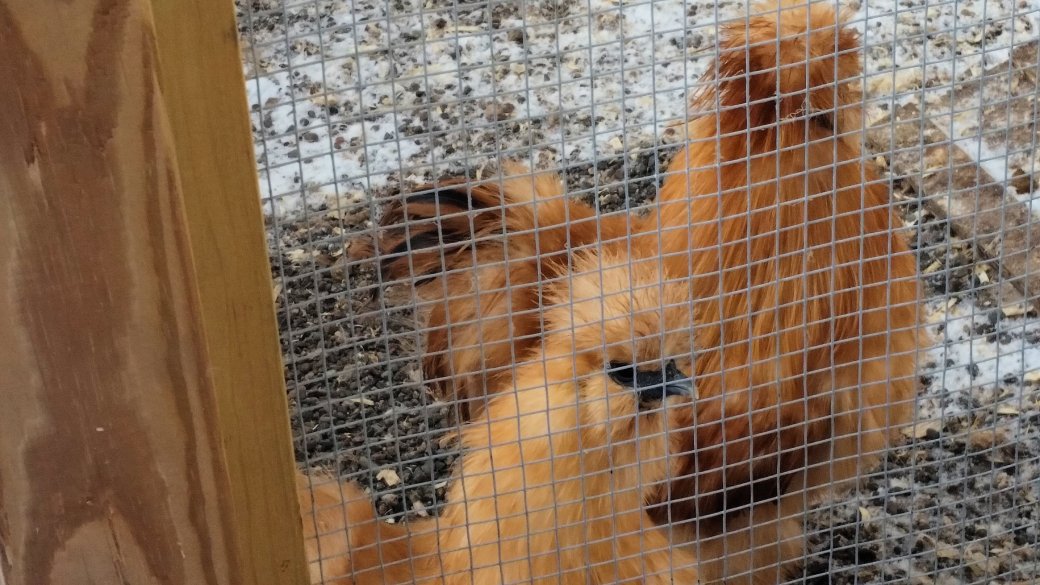
Chickens are very social animals.  There is an order of dominance or what is called a “pecking order.”  The correct  integration of new birds is important.  You need to manage the pecking order so that new birds and chicks do not get hurt and the original flock does not become overly stressed.

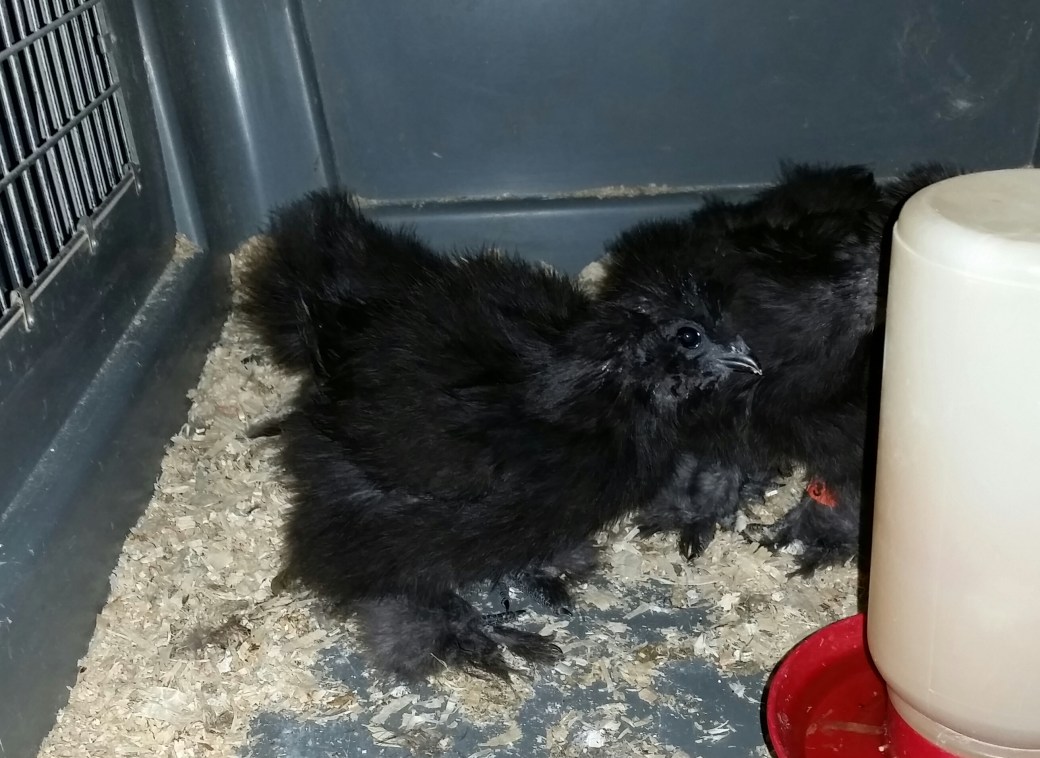
When you first acquire new adult birds, they will need to be quarantined before you can mix them in with your home flock.  This is for the safety of your flock.  Do not quarantine them in the same area as your current birds.  Have a separate pen or crate away from the others.  They will need a place they can stay for thirty days.  You do not need to quarantine chicks that you buy from a hatchery as these are not exposed to an adult flock that may contain germs.

Each flock of chickens has their own germs that make them immune to certain things in their environment.  A new bird will not have that immunity.  This would  be a good time to give it some probiotics or Rooster Booster to help supplement its immune system.  A feed with extra protein will help it deal with the stress of being in a new place.

The new adult bird may also have some hidden issues.  Check for lice, mites, breathing problems or discharge from the eyes or nostrils.  A little poultry dust in case of mites or apple cider vinegar in the water for general health wouldn’t hurt.  Disease can take up to a month to show itself in a healthy bird.  Make sure that you practice biosecurity  and wash your hands when handling new birds.

It is best to introduce new birds in pairs or more. Do not buy a single bird and expect it to smoothly be accepted by the others.  Being alone and new is a double disadvantage.  If there is more than one bird introduced at the same time , they will then have a buddy to hang out with.  There is also more than one bird to take all of the pecks that will be directed their way.

Always add birds of a similar size to the flock. Larger breeds are always more dominant and will bully the smaller breeds. If you have a flock of Jersey Giants it would be difficult for a small bantam to be accepted.  Try to wait as long as possible to introduce young birds.  They should be done making baby noises and be as fully feathered out as possible.

The first step is to separate them in the coops and outside runs.  The idea is to keep them separate but visible to each other.  Seeing but no touching each other. They may try to fight through the fence but they can’t hurt each other.  Poultry netting is a good way to separate them.  Even just a dog crate sitting in the run will work.  Do this for a few days to a week.

When it is time to actually put the birds together there is a few ways you can do it.  Some people think that the best time to do it is at night after they have gone to bed.  Stick the new ones on the roost and they will all wake up together the next morning and may be more accepting.

Another method is to do a free range situation.  Let the new birds out to free range first.  Then let the rest of the flock out.  There is plenty of room for the new birds to run and hide or just plain get away from any unwanted pecks.

If you don’t let your birds free range, you can put the new birds in the run first and then let the older flock out. By letting the new birds out first, they can find out where the food and water is first. Distract the flock with treats so they won’t be so focused on the new chickens.  Make sure that you have multiple feeding dishes and watering stations.  The older flock may try and block the new birds from eating and drinking.

Make sure that they have plenty of room.  Overcrowding will stress everyone out and make the older birds resentful.  Put out more food and treats than they actually need.  Flock blocks can be helpful.  Hiding places are also important.  Just placing a piece of wood against a wall can provide a hiding place for a scared bird.

I know that it is hard, but the less interference from humans the better.  Unless there is blood it is best to let them work it out themselves.  If a bird is super aggressive towards a new one, put it in a dog kennel for a few days.  When it comes out, it will become a “new” bird and be taken down a peg or two.

Two or more roosters will not get along unless they are raised together and are not where they can see hens.  Ten hens per rooster is the recommended amount.  Don’t introduce a new adult rooster to a flock that already has a rooster. They will fight for dominance.

After you have introduced new birds, watch to make sure that they are eating and drinking.  Give them plenty of places to hide behind.  Put everyone on the same food and have separate dishes of oyster shell.

The introduction of new birds can cause your old flock to stop egg production for awhile until things settle down.  It will take a few weeks but soon everyone will have a new place in the pecking order.

For tips and tricks for raising outstanding silkies check out our Chicken Learning Center at VJPPoultry.com .  VJP Poultry is an NPIP and state inspected hatchery located 30 miles north of St. Paul.  We hatch out silkies all year long so we always have stock available.  Like us on Facebook to get weekly updates on what we currently have for sale.

Victoria J. Peterson

20180413_125506-1

Feeding Strategies for Silkie Chickens in the Winter

bestFeeding chickens in the winter is a little different than feeding chickens during the rest of the year.  During nice weather, chickens love to forage and free range in the pasture looking for the choicest bits of protein and green roughage.  They are so happy and content and their minds are fully occupied. In the winter, however, there are limited opportunities to free range. They do not like snow and in Minnesota their chance of finding bugs is slim to none.

Hens that are laying eggs need extra protein all year round and its not just the right kind of food but the right amount of food that is important as well.  As winter approaches , a chicken’s feed consumption will be 1.5 times the amount they eat in the spring and summer.  You will notice an increase in your feed bill and you will be filling those feeding dish more often.

This increase in food consumption is due to the fact that they are coming off of their fall molt and need energy to regrow feathers.   They are also using more energy in order to keep warm in the winter.  They can’t just put on another sweater. They have to generate body heat to keep themselves from freezing.  If they were free rangers they no longer have access to free food in the form of bugs and greens.  Instead they will be increasing their feed consumption in their feeding bowls.

The most important thing to remember when feeding in the winter is to  make sure that they are getting plenty of their regular, nutritious feed.  Some people have their hens on layer food which has calcium in it. It is around 16% protein.  I like to feed mine a Gamebird feed which has a higher percent of protein.  I think that silkies benefit all year round from that higher 24% protein. These basic feeds are created to give your bird the correct amount of vitamins and minerals that they need. This is what they should be eating most of the day.  Add Oyster shell to the feed for eggshell development.  I also put vitamins in their water because I think that silkies need that extra amount of nutrients.

Carbohydrate treats help to keep your birds warm especially on exceptionally cold days. The best sources are what you would find in chicken scratch.  Cracked corn, oats and wheat. Scratch scattered around the coop or run will also give the birds something to do and keep them occupied.  Remember to offer grit with the scratch.  In the winter the small rocks in your run may be covered in snow not allowing the chickens to find their own grit.  They need the grit in their crops in order to grind up these scratch grains.

Some people make a nice bowl of warm oatmeal for their chickens on cold mornings. It is a great treat to warm up their insides.  Just use regular breakfast oatmeal but make sure that you are not serving it too hot.  Cracked corn is a wonderful winter treat. I give mine to my silkies right before bedtime. They will go to bed with a full crop and be warm all night. Watch out for cracked corn turning white silkie’s feathers a yellow tinge on their necks and crests. I usually feed oatmeal instead of corn to the whites.  Also, be aware that too many carbohydrates will make your chickens overweight.  A heavy hen is not a good layer so be careful with the amount of treats.  Treats should be given later in the day as the birds need the nutrients from their main feed first.

Sprouting grains and fodder is a great way to bring the goodness of the outdoor summer pasture all year round.  Sprouting grains can increase the enzyme, vitamin and protein content of any seed.  I have sprouted and fed my birds both oats and wheat.  If you would like to learn how to sprout check out “Sprouting Grains and Growing Fodder” in our blog archives.

Live mealworms can be grown at home or ordered as a fun protein treat.  You can grow them using wheat bran as bedding.  If you are not sure that you want to deal with live mealworms, they also have the dried form which the birds also enjoy.  You can also order live crickets which your hens will have no trouble gobbling up.  There are freeze dried crickets as well.

Boredom is common during the winter in the coop.  You don’t want the birds to turn on each other in desperation for something new and interesting to do. Try hanging a cabbage or head of lettuce in one of these treat balls. They will spend hours trying to get at those leafy vegetables.  Be sure and feed extra greens such as kale, collard, chard and spinach.  Leftovers from your salads are great for them as are any kitchen scraps.

Flock Blocks are popular because they lasts a long time.  Chickens have an instinct to peck at things.  Better to have them pecking at a flock block than pecking at each other during the winter months.

If you are offering treats to your flock outside in the winter, make sure that you are placing it in some kind of bowl or feeding dish.  The ground can be very wet outside in the winter.  If you sprinkle food on the ground it will get soggy.  Birds do not like soggy food.  Make sure you clean up any left over food and pellets.  If you don’t it will attract pests such as mice.  Store extra food safely in sealable containers so you don’t attract predators.

For tips and tricks for raising outstanding silkies check out our Chicken Learning Center at VJPPoultry.com .  VJP Poultry is an NPIP and state inspected hatchery located 30 miles north of St. Paul.  We hatch out silkies all year long so we always have stock available.  Like us on Facebook to get weekly updates on what we currently have for sale.

Victoria J. Peterson


20180123_121432