Feeding Strategies for Silkie Chickens in the Winter

bestFeeding chickens in the winter is a little different than feeding chickens during the rest of the year.  During nice weather, chickens love to forage and free range in the pasture looking for the choicest bits of protein and green roughage.  They are so happy and content and their minds are fully occupied. In the winter, however, there are limited opportunities to free range. They do not like snow and in Minnesota their chance of finding bugs is slim to none.

Hens that are laying eggs need extra protein all year round and its not just the right kind of food but the right amount of food that is important as well.  As winter approaches , a chicken’s feed consumption will be 1.5 times the amount they eat in the spring and summer.  You will notice an increase in your feed bill and you will be filling those feeding dish more often.

This increase in food consumption is due to the fact that they are coming off of their fall molt and need energy to regrow feathers.   They are also using more energy in order to keep warm in the winter.  They can’t just put on another sweater. They have to generate body heat to keep themselves from freezing.  If they were free rangers they no longer have access to free food in the form of bugs and greens.  Instead they will be increasing their feed consumption in their feeding bowls.

The most important thing to remember when feeding in the winter is to  make sure that they are getting plenty of their regular, nutritious feed.  Some people have their hens on layer food which has calcium in it. It is around 16% protein.  I like to feed mine a Gamebird feed which has a higher percent of protein.  I think that silkies benefit all year round from that higher 24% protein. These basic feeds are created to give your bird the correct amount of vitamins and minerals that they need. This is what they should be eating most of the day.  Add Oyster shell to the feed for eggshell development.  I also put vitamins in their water because I think that silkies need that extra amount of nutrients.

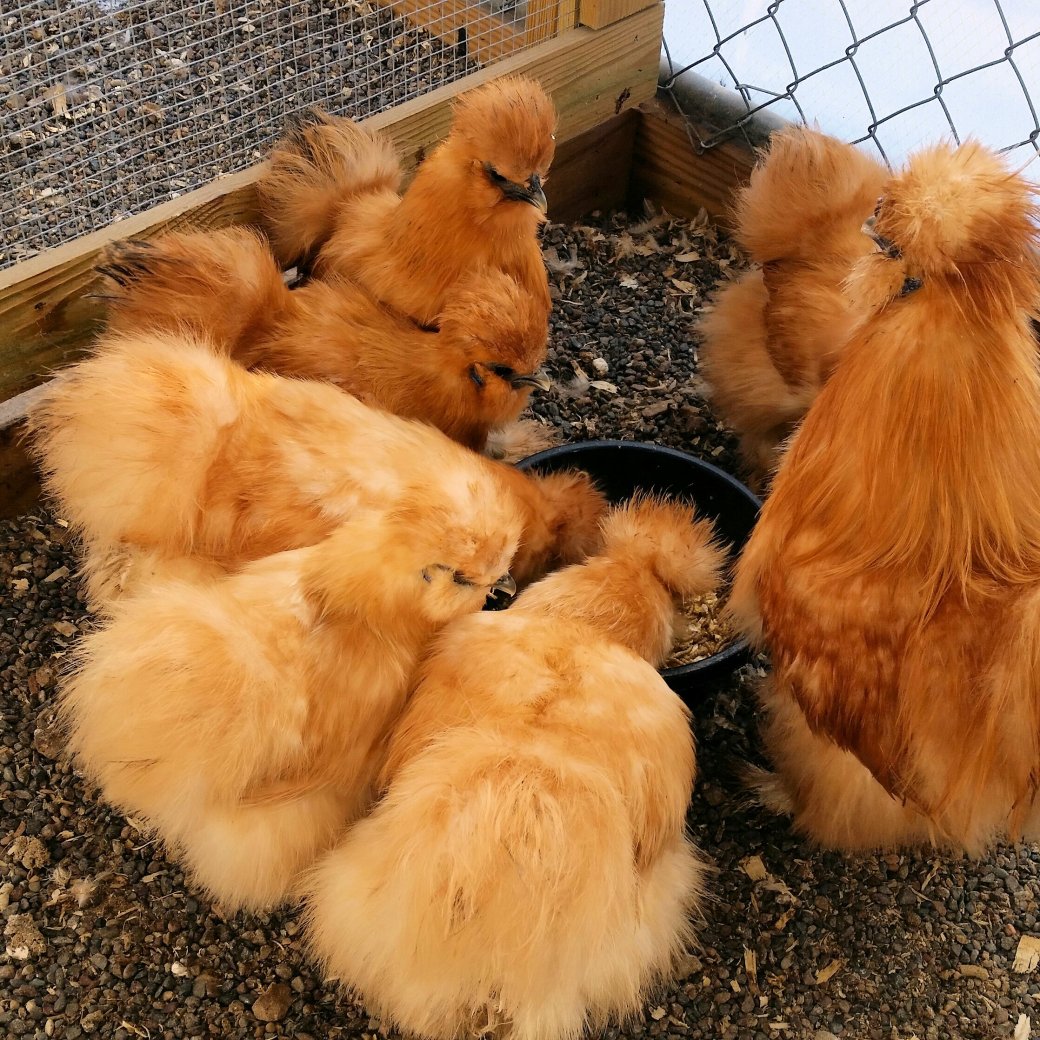
Carbohydrate treats help to keep your birds warm especially on exceptionally cold days. The best sources are what you would find in chicken scratch.  Cracked corn, oats and wheat. Scratch scattered around the coop or run will also give the birds something to do and keep them occupied.  Remember to offer grit with the scratch.  In the winter the small rocks in your run may be covered in snow not allowing the chickens to find their own grit.  They need the grit in their crops in order to grind up these scratch grains.

Some people make a nice bowl of warm oatmeal for their chickens on cold mornings. It is a great treat to warm up their insides.  Just use regular breakfast oatmeal but make sure that you are not serving it too hot.  Cracked corn is a wonderful winter treat. I give mine to my silkies right before bedtime. They will go to bed with a full crop and be warm all night. Watch out for cracked corn turning white silkie’s feathers a yellow tinge on their necks and crests. I usually feed oatmeal instead of corn to the whites.  Also, be aware that too many carbohydrates will make your chickens overweight.  A heavy hen is not a good layer so be careful with the amount of treats.  Treats should be given later in the day as the birds need the nutrients from their main feed first.

Sprouting grains and fodder is a great way to bring the goodness of the outdoor summer pasture all year round.  Sprouting grains can increase the enzyme, vitamin and protein content of any seed.  I have sprouted and fed my birds both oats and wheat.  If you would like to learn how to sprout check out “Sprouting Grains and Growing Fodder” in our blog archives.

Live mealworms can be grown at home or ordered as a fun protein treat.  You can grow them using wheat bran as bedding.  If you are not sure that you want to deal with live mealworms, they also have the dried form which the birds also enjoy.  You can also order live crickets which your hens will have no trouble gobbling up.  There are freeze dried crickets as well.

Boredom is common during the winter in the coop.  You don’t want the birds to turn on each other in desperation for something new and interesting to do. Try hanging a cabbage or head of lettuce in one of these treat balls. They will spend hours trying to get at those leafy vegetables.  Be sure and feed extra greens such as kale, collard, chard and spinach.  Leftovers from your salads are great for them as are any kitchen scraps.

Flock Blocks are popular because they lasts a long time.  Chickens have an instinct to peck at things.  Better to have them pecking at a flock block than pecking at each other during the winter months.

If you are offering treats to your flock outside in the winter, make sure that you are placing it in some kind of bowl or feeding dish.  The ground can be very wet outside in the winter.  If you sprinkle food on the ground it will get soggy.  Birds do not like soggy food.  Make sure you clean up any left over food and pellets.  If you don’t it will attract pests such as mice.  Store extra food safely in sealable containers so you don’t attract predators.

For tips and tricks for raising outstanding silkies check out our Chicken Learning Center at VJPPoultry.com .  VJP Poultry is an NPIP and state inspected hatchery located 30 miles north of St. Paul.  We hatch out silkies all year long so we always have stock available.  Like us on Facebook to get weekly updates on what we currently have for sale.

Victoria J. Peterson
 

20180123_121432


The Grooming Process – Primping your Silkie for the Show

20171018_103551-1    It’s a week until the poultry show and it’s time to think about primping, prepping and grooming your birds so that they all look their best.   All of them will need to be bathed, toenails trimmed and beaks clipped and filed.

I find that I can bath around three birds a day successfully.  On the Monday before the show I will trim toenails and beaks. I always do those two jobs before I start baths.  If there is any bleeding the blood will not get into your bath water.

I use a diagonal wire cutter on the toenails.  Do not trim too short or you will cut the quick and your bird will begin to bleed.  Use an emery board to file down the sharp edges.  There should be no sharp points which can scratch and hurt a judge.  Remove any dirt or poo from the foot prior to the up coming bath.  Hydrogen Peroxide and a cotton ball is good for loosening up all of that dirt especially in the scaly part of the leg. Hydrogen Peroxide is good for about one month after opening the lid. Exposure to air will lesson its abilities.

You will need to clip your bird’s beak if the top beak creates an overbite to the bottom beak.  A toenail clipper works best for this job.  The beak should come together with no overhang.  File it with an emery board to sand away any rough edges.

I will start bathing the silkies on Tuesday starting with with the darkest birds The lighter ones will be done later in the week.  I only do three a day because it takes a while to do a thorough job.  I also want to make sure that they are dry enough to be placed back outside.  Always bath your silkies in the morning so that  they will be thoroughly dry by the time they go to sleep at night.  It is very important that they do not go to bed damp.

Before starting the bath, I take the hydrogen peroxide and pour it into a small dish. I then take cotton balls and carefully clean around the eyes, beak and crest.  Its like a good face washing. The hydrogen peroxide will help to break down the organic dirt and poo that sticks to the feathers. I also use an old tooth brush to clean the scales and toes with the peroxide.  You could put some Spray ‘n Wash on the foot feathers if the are very stained.

I bathe my birds in the laundry room sink.  It has a spray attachment which I really find handy.  I start by gathering all of my supplies.  You don’t want to be hunting for things when the bird is already wet and starting to get chilled.  I will even have the hair dryer and combs all set and ready to go.

I first fill two large buckets with warm water. I fill them about waist high to the bird.  Into one bucket I put about 1/2 cup white vinegar.  The other is just plain water for the final rinse but you could add glycerin to it.

I put the bird in the sink and begin soaking the feathers in warm water. If you think that your bird might have mites, I would start with a flea and tick shampoo.  I use blue Dawn or Ivory for the first wash.  The Dawn dish foam pump is nice because it is easy to use while holding a bird in one hand.

20171018_101721-1   I start with the crest and then work my way down.  Dirty areas include the crest, beard, vent and foot feathers.  I use the sprayer to carefully rinse the Dawn soap out.  To remove the soap from the crest, I tip the bird upside down and then rinse with the sprayer.  This way the soap does not drip into its eyes.

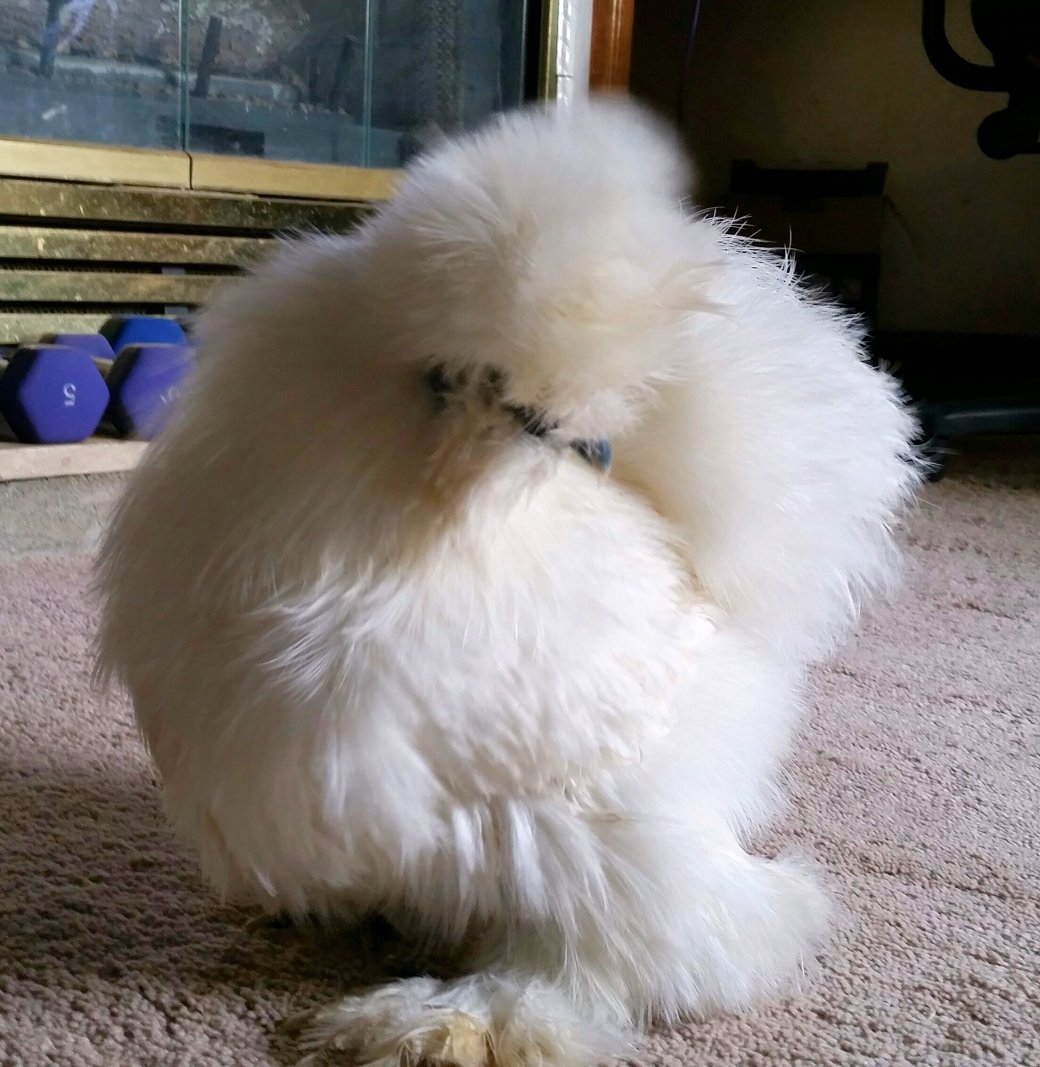
White birds can become dingy in color turning a grey or yellow.  This can happen from being out in the sunlight too often or being fed corn which discolors white feathers.  Adding bluing to your dingy whites will make your whites appear whiter.  The effect is not permanent and bluing will wear off.

The second shampoo is either a bluing shampoo if it is a white bird or a color enhancing shampoo if it is a dark colored bird.  Horse shampoos offer a variety of colors.  I use the Gallop brand but you could also use a human bluing shampoo or just add laundry bluing to the water.  Be careful with the bluing shampoo that the bird is soaking wet before applying or you may end up with a dyed blue or purple chicken.

Rinse as much soap off as you can with the sprayer and then place the bird in the bucket with the vinegar rinse.  The vinegar will cut the soap so that it does not stick to the feathers.

Place the bird in the final rinse water.  Always hang on tightly to your bird.  Do not let its beak go under the water line.  You can add some glycerin to the final rinse for extra shine.  Remove the bird and squeeze as much water out as possible.  Then wrap it tightly in a towel to absorb water and help it stay warm.  It should look like a silkie mummy.

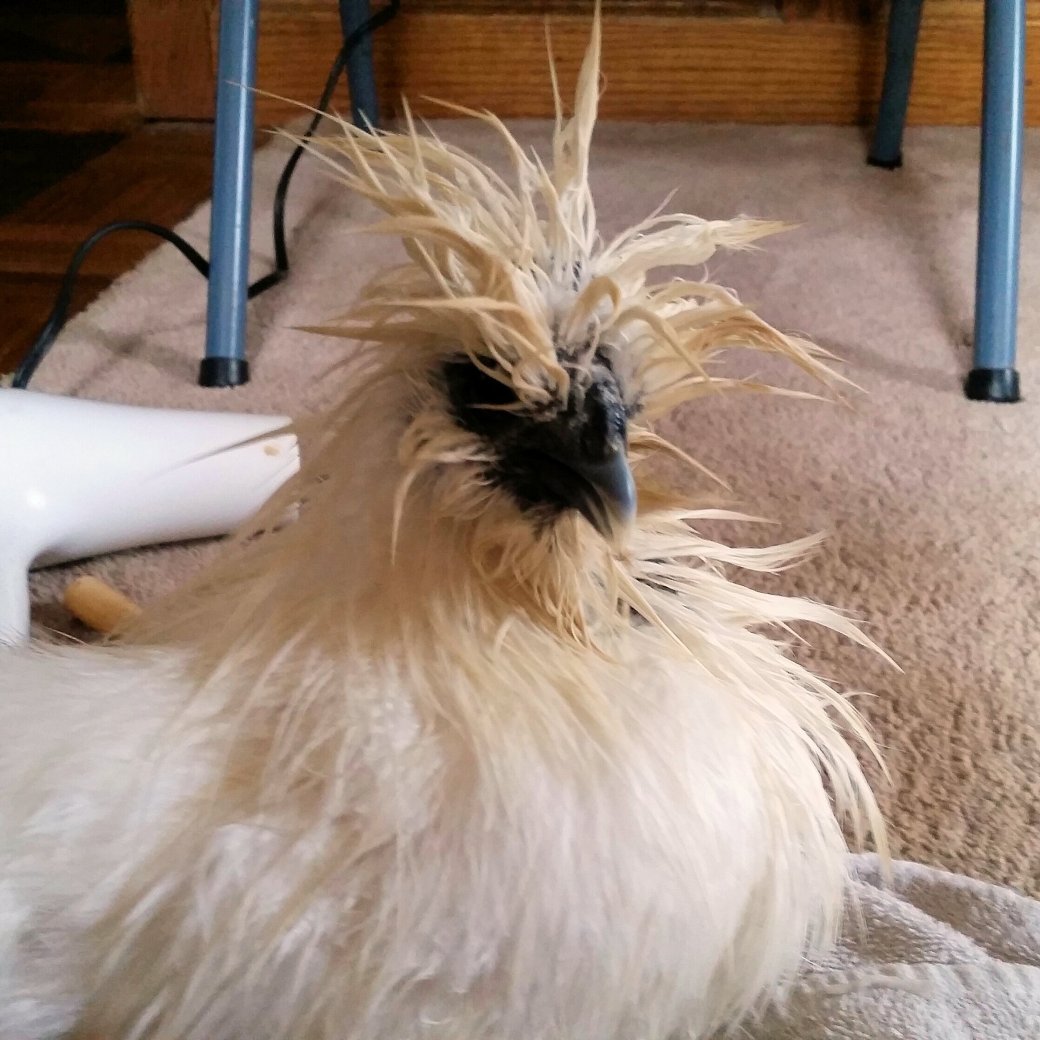
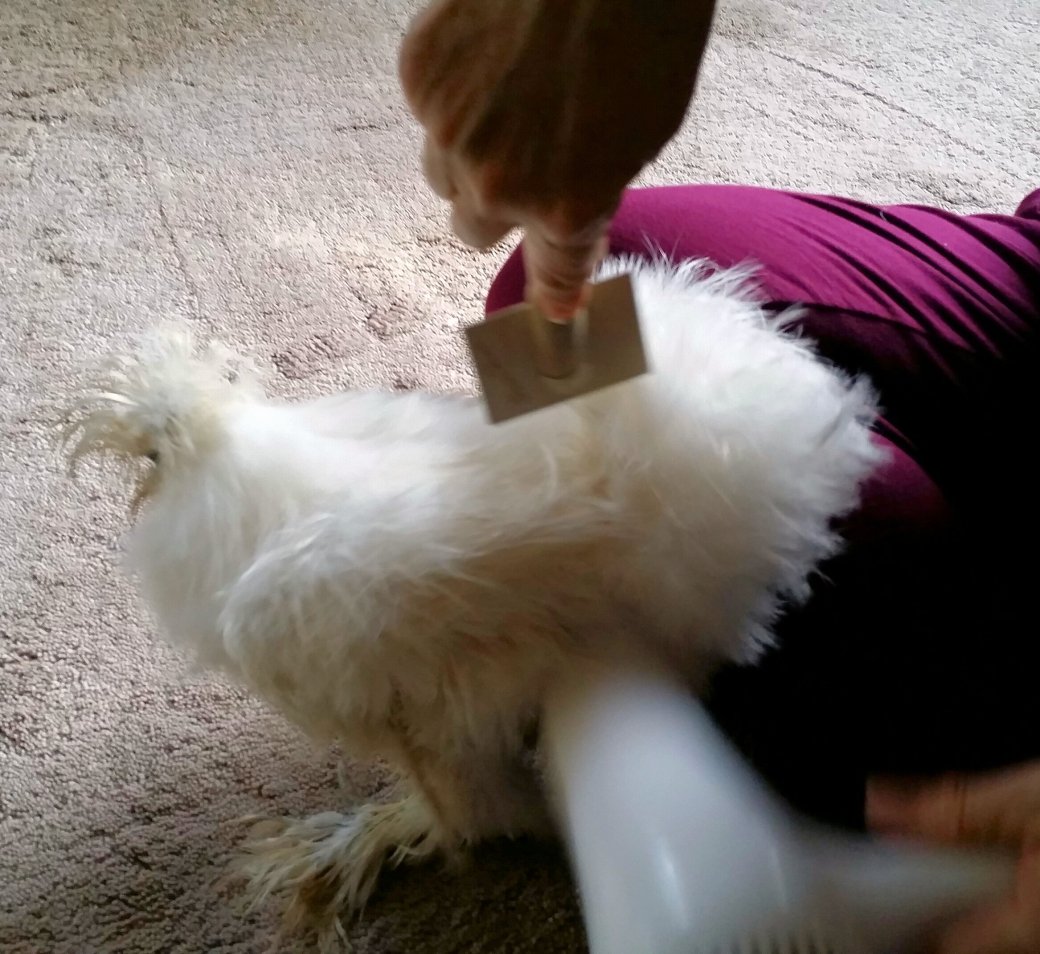
I leave the bird tucked up in the towel but begin to use the hair dryer on the crest.  Use the low setting on the hair dryer so as not to burn the skin of the silkie.  I gradually undo more of the towel as I do drying the bird and fluffing the feathers with my fingers.  You can also use a comb or slicker brush.  It will take a while to get it dry enough that she can finish the job herself.  If it is cold out have her stay somewhere warm like a  bathtub until she is dry enough.  She will finish preening and applying oil from her oil gland.  Baths should be at least one full day before leaving for the show to get the natural oils back on the feathers.  Add some Vet Rx to shine up the toes and comb.

Place your bird in a separate small holding coop that has fresh shavings or back in her old coop which would also have new shavings put down.  Keep her locked up and out of the muddy run.  Remove any poo you see so that she is not stepping in it.

Some people put booties on their feathered feet to keep their foot feathers from staining.

Hopefully your bird will stay clean until it is time to pack up and head for the poultry show.

For tips and tricks for raising outstanding silkies check out our Chicken Learning Center at VJPPoultry.com .  VJP Poultry is an NPIP and state inspected hatchery located 30 miles north of St. Paul.  We hatch out silkies all year long so we always have stock available.  Like us on Facebook to get weekly updates on what we currently have for sale.

Victoria J. Peterson
 

20171018_102406(0)-1

Cage Training For The Silkie Show

20171003_115002-1

Fall poultry shows are coming up and hopefully, if you are planning on showing, you have selected your birds that you are bringing and are in the process of conditioning them.

Conditioning means that you have separated your selections from the rest of your flock and have made sure that the boys and the girls are not in the same pen.  Separate areas are important as rowdy boys can break or tear feathering on the females.

You should also be feeding them a diet that is high in protein to keep those feathers in tip top shape.  Showbird food or Feather Fixer are good choices.  I also add vitamins to the water or Roster Booster to improve the over all health and beauty of the bird.

About a month before the show you will want to start training your birds to be comfortable in a small wire cage.  These are the type of cages you will find at a poultry show.  They are about 24 X 24 in size.  Place the cage on saw horses so that they are about table high.

This enclosed cage will be very different from what your silkie is used to out in the coop.  I would start with short time spans and then gradually increase how much time the bird spends in there.

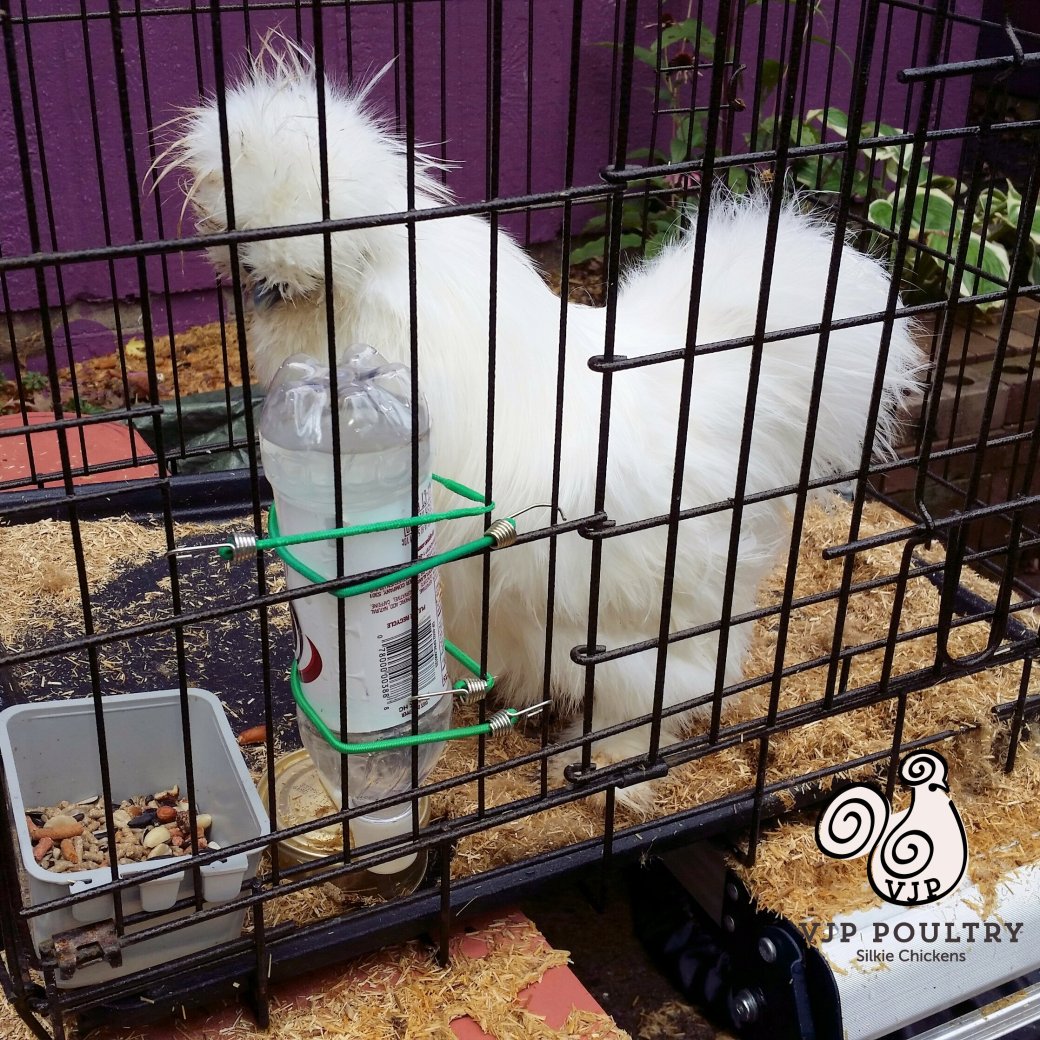
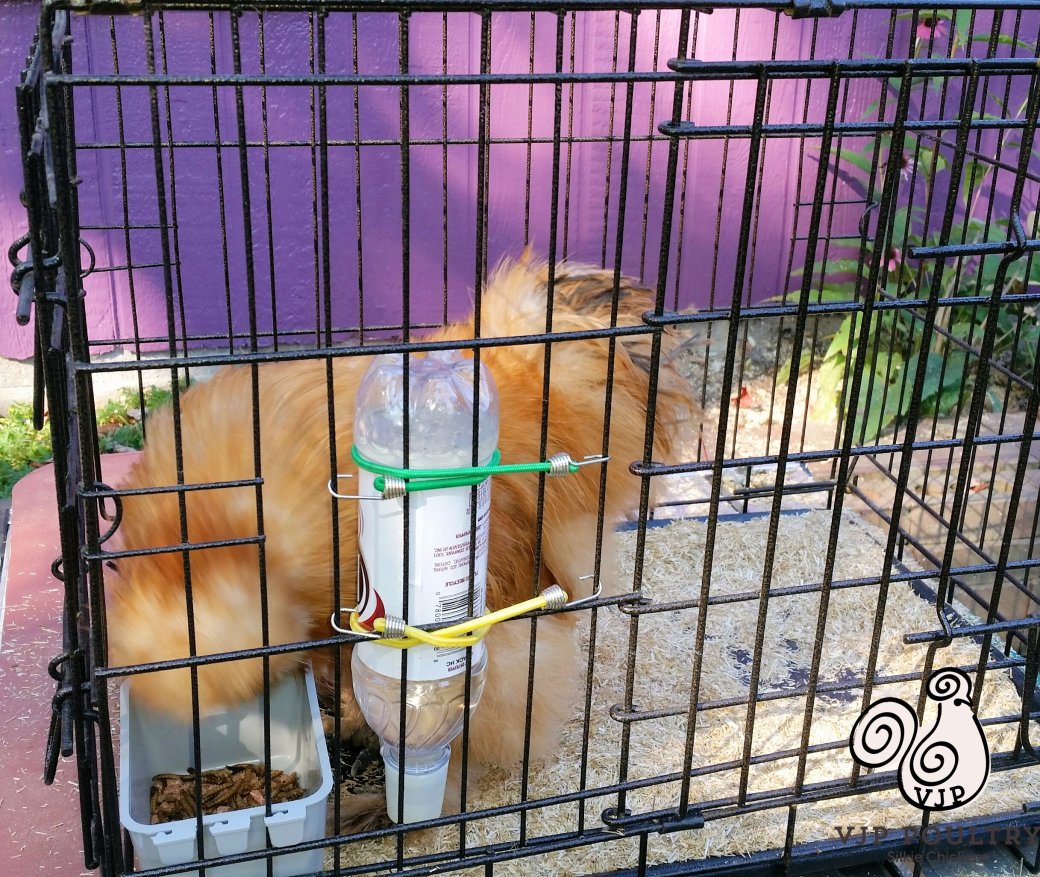
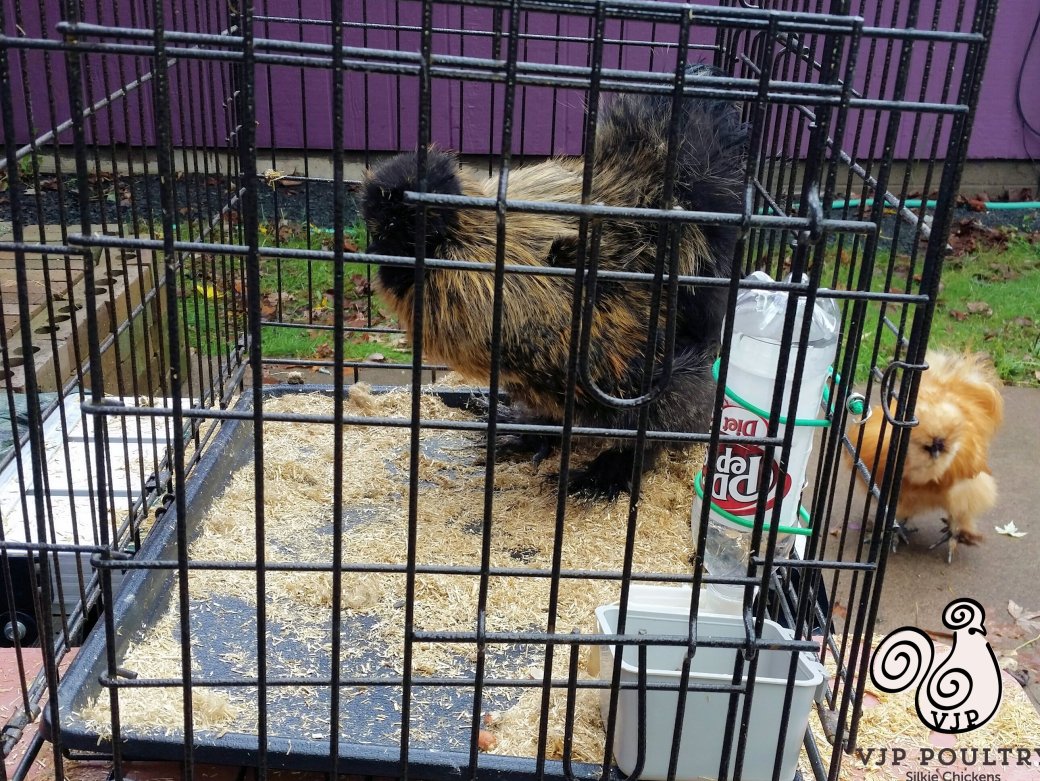
You will need to teach your bird how to eat and drink inside of the cage.  A good waterer for silkies is the pop bottle waterer.  You buy the bottom where the birds drink from and then place a plastic pop bottle with water in it on top. They provide a spring to secure it on the side of the cage but I use small bungee cords and place something underneath the bottom to support it. I use an empty cat food can.  I like these because they are small and don’t take up much space in the cage and because the silkie is less likely to dunk their heads and get wet and messy.  You will want the judges to see a clean, dry bird.  It is a good idea to remove the waterer before judging starts to keep your bird looking perfect.

The food container hangs on the side.  I like to put food they really like in there while you are training them.  Treats such as mealworms, sunflower seeds and berries, or cracked corn will teach your bird how to eat from the little container.  They will begin to associate treats with time spent in the cage.

Learning to eat and drink from these different containers is very important.  Silkies who have not had their feathers trimmed around their eyes will have a hard time finding the food and water in the cage.  Use pink hair tape or blue painters tape to pin up the feathers in the crest which will allow the birds to see.

20170927_110033-1

Place the feeders and waterers in the front of the cage.  This will get them used to being on that side of the cage where the judge will be.  A judge does not want to see a bird cowering in the back.  They should be up front where they are easy to see and judge.

The judge will have a little baton that he uses to get the bird to pose properly.  You should practice with a dowel or stick so that your silkie is used to seeing it in the cage and feeling it against its body.

Shows are very noisy places.  You may want to place a radio by your cage so that the bird gets used to loud noises while they are in the cage.  I have the radio tuned to the Oldies station that has lots of commercials.

Practice taking your bird in and out of the cage.  The judge will be taking the bird out head first and placing it in the cage head first. You should practice the same way.  Hold the bird with one hand under the keel one hand on top of the wings.  Birds will struggle if they are not used to being handled.  Judges would rather not work with struggling birds.  Spread the wings out and check all over the bird the same way a judge would.

Give the bird a treat while handling them so that they associate people holding them with treats. Treats include Chicken Crack, Happy Hen Treats, Grublies, and Mana Pro Garden Delights.  Roosters will especially need practice in handling.  Sit with them on your lap when you are watching tv and cuddle up with them.  You will enjoy it and so will they.

For tips and tricks for raising outstanding silkies check out our Chicken Learning Center at VJPPoultry.com .  VJP Poultry is an NPIP and state inspected hatchery located 30 miles north of St. Paul.  We hatch out silkies all year long so we always have stock available.  Like us on Facebook to get weekly updates on what we currently have for sale.

Victoria J. Peterson

20171003_115434-1.jpg