Feed and Treats For Adult and Juvenile Chickens.

bestChickens are Omnivores.  They are opportunistic eaters.  They will eat foods of both plant and animal origins.  They love treats and are easy to spoil. What they are fed can make a huge difference in their egg production, reproduction ability and overall lifespan length. It is important that they are given foods that have good nutritional value and are natural for their behaviors as chickens.

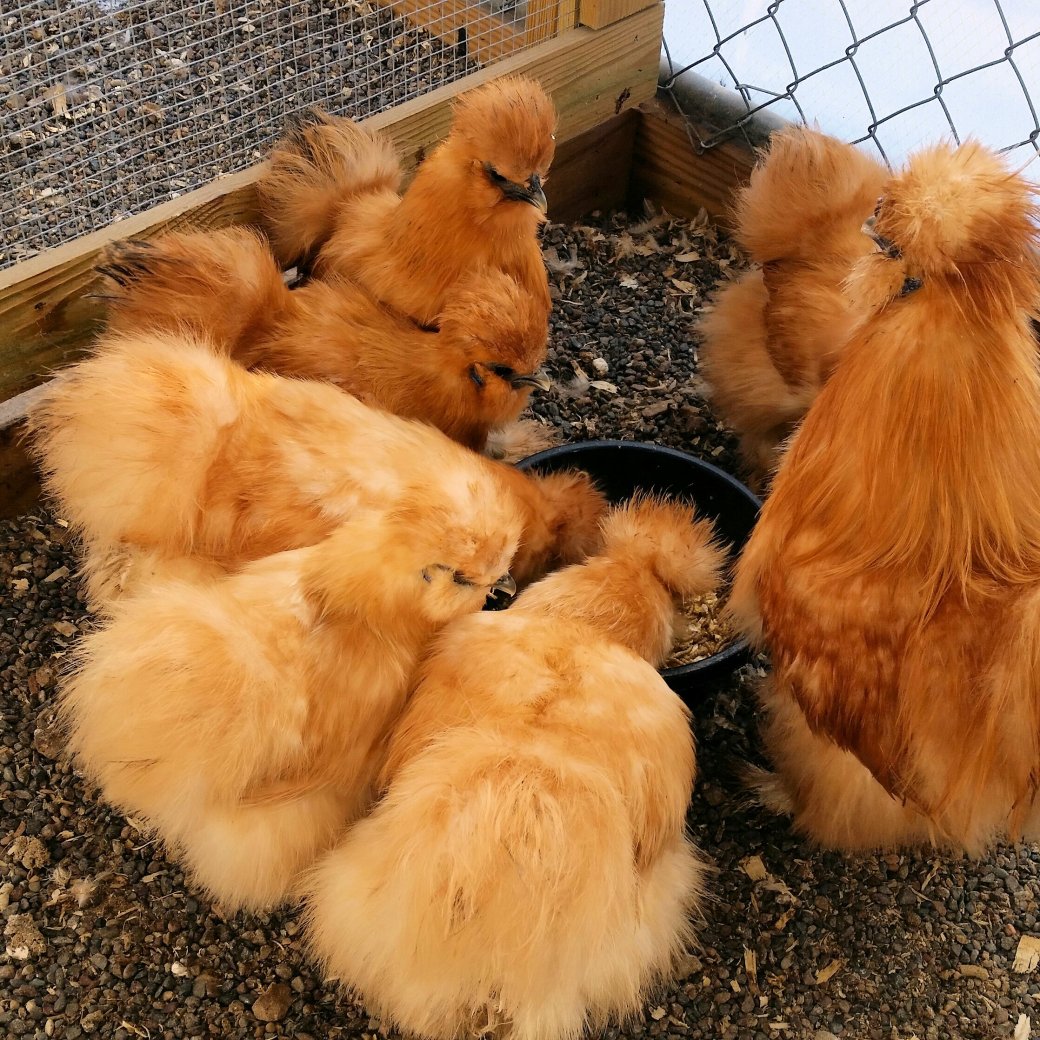
When chicks are little they eat Chick Starter as their main source of food.  At around 10  weeks they can begin Grower Feed. This feed is around 16% protein and is designed to sustain growth all the way to maturity. Gamebirds will need a higher protein content such as a Gamebird Conditioner feed.  I feed my silkies Gamebird Conditioner which has a protein content of 20%. If you are raising meat birds they will need their own separate Meat Bird Grower Crumble for fast growing birds. They require a protein content of 20-24%.  The basis of any good chicken diet is a high quality poultry pellet or crumble. Most if not all of its nutritional needs should come from that feed. It is complete and balanced and does not need anything added to it for optimal development of the bird.

Layer feed can be given once the pullets have begun laying eggs. It should not be given before that time as the higher calcium content can cause damage to their kidneys as they are not using the calcium for eggshell development.  Layer feed should not be given to roosters as it can be detrimental to their kidneys as well. Layer feed is designed to provide optimum nutrition for birds laying eggs. It contains 16% protein and increased levels of calcium for proper shell creation. Average laying hens will consume 1/4 pound of feed per day depending on the size of the bird, weather conditions and level of productivity.

Another type of feed is All Flock.  It is designed for adult birds but does not contain the added calcium.  You can feed it to a mixed flock of ducks, geese, turkeys and chickens. When feeding this to laying hens, you will need to offer some Oyster Shell in order for them to get the needed calcium for shell development. Offer it in a separate bowl from regular feed and the hens will eat it as needed.

Scratch is a mix of cracked rolled or whole grains such as corn, barley, oats or wheat.  It is low in protein and does not provide balanced nutrition such as a commercial feed would. However, as the name implies, it is food that is thrown on the ground and the chickens get to scratch around in the dirt for it. Scratching for food is a very natural behavior for chickens and is a good form of exercise for them. Only feed them as much scratch as they can totally consume in 20 minutes.

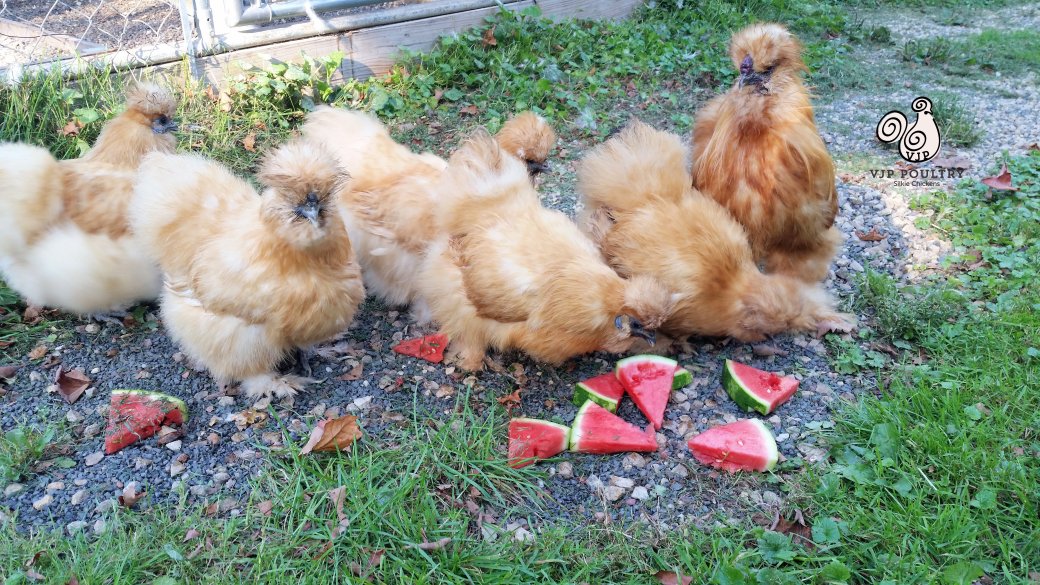
Table scrapes are routinely given to chickens but should be thought of as a treat.  Most food scrapes are fine but some are better than others. Feed bread in moderation as it has little nutritional value. Cat and dog food are sometimes given during molting because of the high protein content. Citrus is usually frowned upon as it may interfere with calcium absorption and cause soft egg shells. Dairy products should be fed in moderation as chickens have a hard time processing large amounts of dairy. No dry beans or uncooked rice.  Watch out for too salty or fatty foods.

Allow your chickens to free range and forage for food when you can.  They love looking for bugs and green plants and the adventure of finding them. Do not feed your chickens grass clipping as this can cause impacted crop. Always provide commercial feed for them. They will not find enough food free ranging in a typical suburban yard.

One way to tame and bond your chicken to you is to occasionally give it some treats.  There are many commercial treats available. Grubblies and Dried Mealwormsare natural insects that have been freeze dried or oven baked.  A poultry Flock Block can be placed in the coop and left for the birds to gradually peck away at it. A poultry Suet Block is made mealworms and sunflower seeds. .  Happy Hens Treats, Kaytee mealworm , and Manna Pro Harvest Delight are all good commercial treats.  As a boredom buster use a treat ball to entertain and provide treats for your chickens.

Too much of a good thing can always be a problem.  Chickens can become obese and develop fatty liver disease. Keep treats down to 20%  or less of their regular diet. Make sure that their commercial feed is always available to them especially before evening. You want to make sure that the chickens go to bed with a full crop which not only keeps them warm but aids in the nightly development of the egg.


For tips and tricks for raising outstanding silkies check out our Chicken Learning Center at VJPPoultry.com .  VJP Poultry is an NPIP and state inspected hatchery located 30 miles north of St. Paul.  We hatch out silkies all year long so we always have stock available.  Like us on Facebook to get weekly updates on what we currently have for sale.

Victoria J. Peterson
20180907_165826


Building a Coop for Silkie Chickens

20180527_124135-1Silkie chickens have slightly different requirements when it comes to housing.  Silkies are different from other breeds of chickens in several ways and these differences can be reflected in the type of coop you end up designing or purchasing.  The only chickens we have at VJP Poultry are silkies so we are always thinking of ways to improve housing with their uniqueness in mind.

The first coop we had was a refurbished ice house. This worked perfect for our needs. It was built very sturdy and was well insulated for winter. We added electricity out to it, put in nest boxes and roosting poles and had a ramp going down to a chain link fence enclosed run.  We had a variety of breeds of chickens to start out with but I really fell in love with the silkies.   I found that the silkies did not “fly” up to the roost pole with the others but would sleep on the floor directly under them. The next morning they would be covered in poo from the roosting birds above them.  They also did not use the nesting boxes, but preferred to find a corner on the floor in which to lay their eggs. Silkies go broody often but can’t fly up to nesting boxes that are very far off of the ground.

In a few years we found a second ice house to refurbish as we continued to expand our chicken habit. By now we only had silkies in our coops. We did not bother putting in a roosting pole or nesting boxes.  We made sure that the ramp to the ground was a long gradual incline.  Silkies do not like high ramps, especially with their eyesight often being blocked by feathers.  I find it best to trim above and below the eyes so that they can find food and water.

The third coop we built ourselves. We overbuilt it, but I was glad that we did. It is very sturdy and tall. There is a long walkway inside with four sections of divided pens. Everything is easily stored inside of the coop, such as food, bedding, brooms and assorted tools. It has electricity.  The pen walls and floor are painted with industrial enamel which is super easy to keep clean. The other coops had plastic sheeting on the floor and sides. I scrubbed them weekly but they eventually started to come away from the walls.  The enamel paint is much easier. A silkie pen needs to be kept neat and tidy. You want them to be looking at their best and poo stains are not attractive.

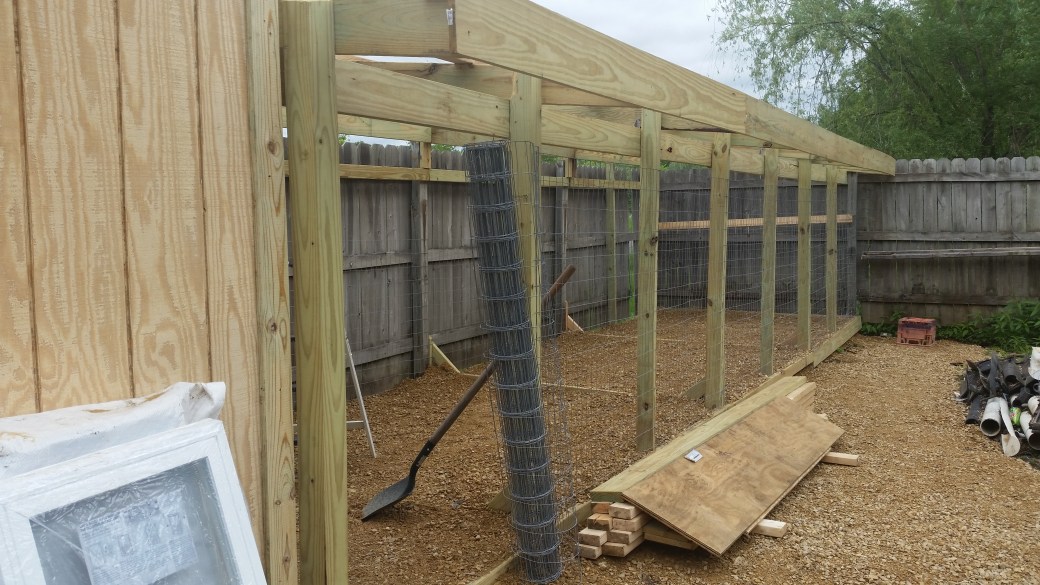
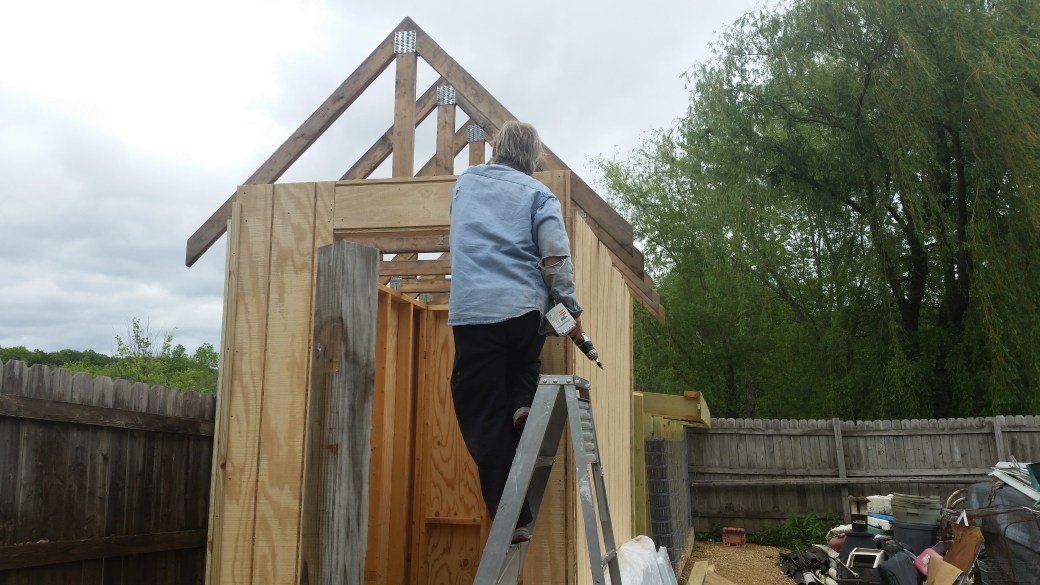
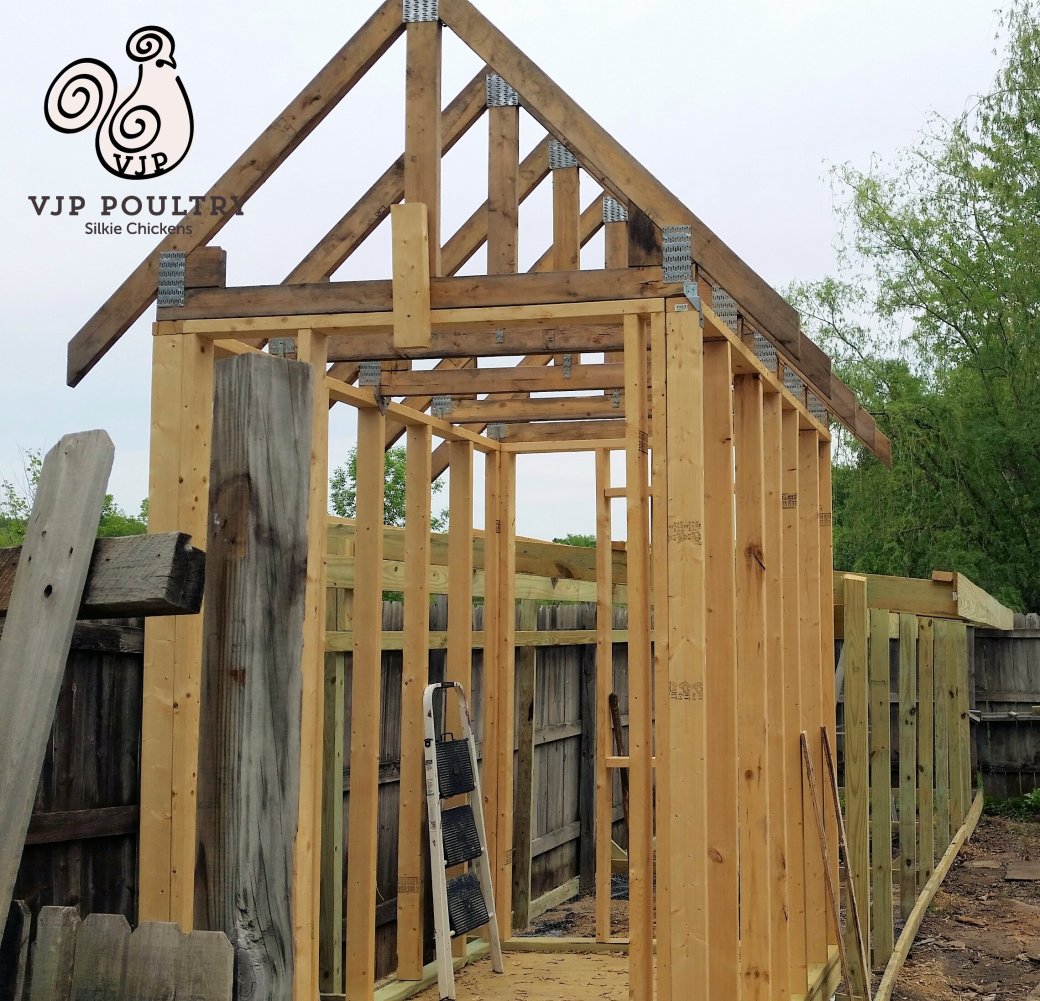
Now we are building our fourth coop and using all of the information gained from the other coops, we are able to have the best silkie coop possible. We started by making the floor of the coop. You want to make it up off of the ground but at the same time as low as possible for silkies. They have a hard time with steep inclines, so the ramps need to be long and low.  Next the walls were built and the roof rafters put on. We put on a metal roof with a steep slant. We want the snow sliding easily off.  The roof has long overhangs.  In the future we will put on gutters.  Silkies do not do well in the rain. Their fluffy feathers do not let water bead off of them. When they get wet, they look drenched.

We installed windows up high, so that there is plenty of air movement. Silkies do not do well with drafts so you want that air moving up above them.  Ventilation is very important to the health of your birds. I keep windows open at all times. Use hardware cloth stapled over the window screens to keep predators from making their way inside.

When making the run, you will want to lay down hardware cloth on the inside and as a skirt around the outside to keep digging predators from making their way in. We piled gravel on top of the the hardware cloth and placed pea rock on top of that.  Silkies have beautiful feathered feet. You want to protect those feathers by having soft bedding or even using dirt or sand in the coop or run.  Large rocks can often break off foot feathers, so use as small of rock as you can.

20180603_113021

We covered the run with a metal sloping roof.  Hawks can be a big problem for silkies. They are small enough to be lifted and taken away. Their crests are large and impedes their ability to look up.  Even their coloration can make them a standout when free ranging. Try to limit their free ranging to when you can be there to watch out for them. Otherwise a covered run is their best protection from flying predators.

Know the silkie predators in your area and design your coop with them in mind.  If your predators are diggers like fox, make sure that you have buried hardware cloth around your run. If you have trouble with weasels or mink, make sure that all small holes are plugged up and windows are secure with hardware cloth.  Larger animals such as bear will need electric wire around the outside.

If you don’t want to build a coop yourself, there are a few coops that are available for sale that are good for silkies. Look for something that is all one level such as this.  The smaller the ramp the better. Coops that are described as rabbit hutches are often on one level .  Look for sturdiness in these pre-made coops that can withstand the elements and predators.  If you live somewhere with a cold climate, you will need to insulate and possibly have heat lamps.

For tips and tricks for raising outstanding silkies check out our Chicken Learning Center at VJPPoultry.com .  VJP Poultry is an NPIP and state inspected hatchery located 30 miles north of St. Paul.  We hatch out silkies all year long so we always have stock available.  Like us on Facebook to get weekly updates on what we currently have for sale.

Victoria J. Peterson
20180603_113007

Why Your Chicken Needs a Dust Bath

20180323_145950-1   All chickens should have access to dust baths.  It doesn’t matter what breed or age of chicken, it is instinctual for them to wallow in the dust and dirt.  It is their way of getting clean and practicing good hygiene.
When you first witness this dust bathing, you may think that something is wrong with your bird.  It almost looks like they are in trouble or having a seizure.  They are lying on their sides with one leg sticking out and the other scraping dirt and dust in kind of a circular motion.  The wings are throwing dirt up into the air so that it falls back down on top of them.  It looks scary , but it is perfectly normal.

Chickens will create a dust bath area all by themselves.  A chicken scratches and digs out a bowl shaped depression in the dirt or will even use the shavings inside of the coop.  The chicken settles into this hollow, fluffs up its feathers and then scratches up the dirt.

It might look like they are making a nest to lay eggs because it is round in shape but these are preparations for dust bathing.  Chickens use their feet and wings to get loose dirt throughout their skin and feathers.  Once they are completely covered in a layer of dirt, the bird will fluff and shake off the substance to evenly distribute it on their bodies.

A chicken’s dust bath helps to remove excess oil, as well as parasites such as lice, mites and ticks.  Dust bathing is an important part of keeping chickens healthy and clean.  It is important that your chicken has access to areas where dust bathing can take place. Most will look for a sunny spot with loose dirt.  Even if they never get to free range, you can set up a dust bath in their coop or pen.

There are four main behaviors when dust bathing: vertical wing-shaking, head rubbing, bill raking and scratching with one leg.  The hen scratches with her feet and beak at the ground.  She then erects her feathers and lies down. They create deep bowls as they wiggle and squirm to get dirt deep under their feathers.  They make happy noises while flipping dirt all over themselves.  The dust collects between the feathers and then is shaken off.  This helps to give the feathers good insulating abilities.

Chickens clean their feathers and skin by preening with their beaks and using an oil gland at the base of their tail. After a dust bath a hen will spend time primping and pecking at their feathers. This helps to smooth their feathers and removes sheaths on new feathers.  Feather maintenance is very important.  Birds of all kinds take dust baths and certain mammals do as well to keep clean and remove parasites.

Most dust bathing occurs in the middle of the day. Warm temperatures increase dust bathing behavior. Hens will tend to dust bath if they see other hens doing it.  It ends up being a very social activity.  It is not just hens that will dust bath, but roosters enjoy doing it as well.

The need for a dust bath is ingrained in their behavior.  They will dig holes if you don’t provide them with a spot.  Free ranging birds will find a place in your garden if you let them.   Battery hens in cages will sham dust bathe.  They will go through the motions of dust bathing even if there is no other material in their cages.

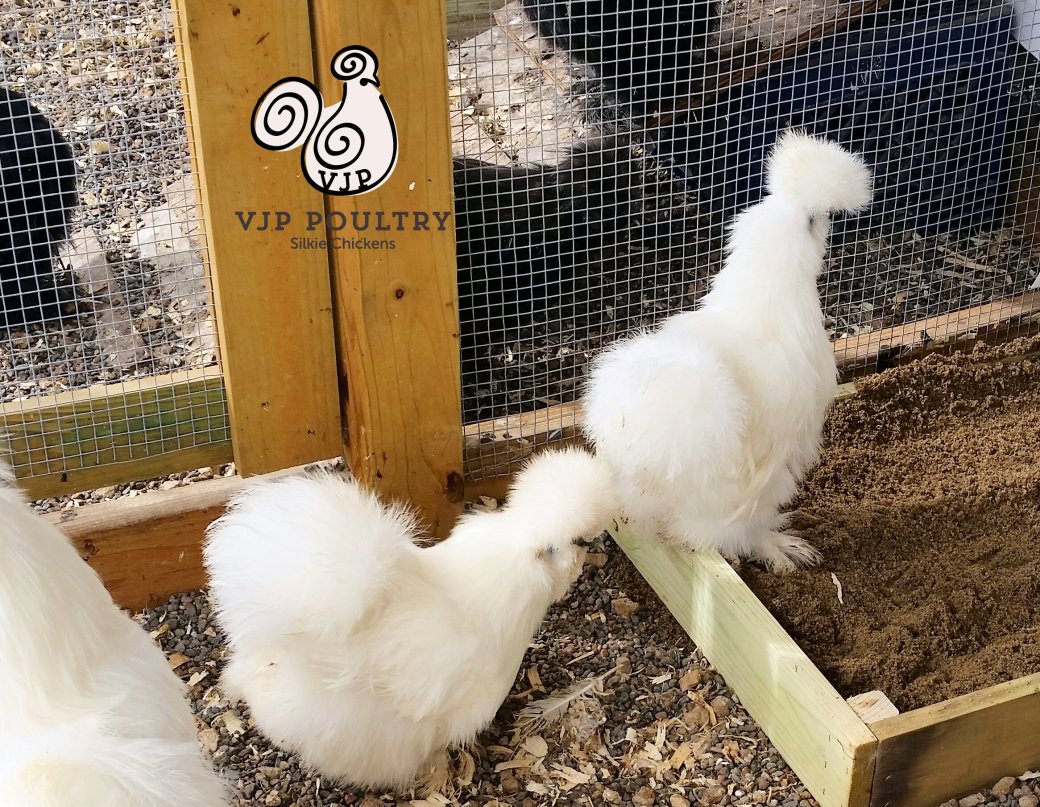
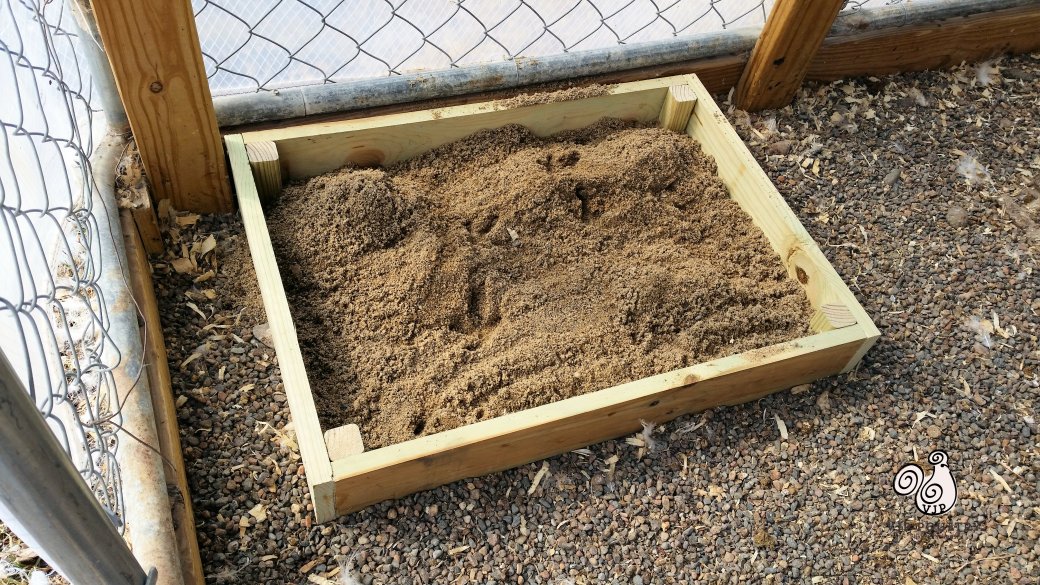
Here at VJP Poultry, we decided it was time to create some dust bathing areas inside of our runs.  We used treated 1″ X 4″ lumber and made 18″ X 24″ boxes with no bottom.  We set them in the run and filled them half full with play sand.

There are other things that you can use to create your dust bathing areas. Any large shallow pan such as a kitty litter pan or small kiddie pools.   Fill it with a variety of substrates.  Some examples would be :  Fine sand, dry dirt,  or peat moss.

Some people like to add food grade diatomaceous Earth or DE.  The sharp edges pierce the soft body parts of parasites and kills them.  Be careful with DE as it can be very harmful if inhaled and can damage lungs.  Use a small amount as part of your substrate.

Firepit ash or ash from a wood stove is another product that can be used. Birds can absorb magnesium, calcium and vitamin K from the ash.  Use ash from hardwood trees and make sure that if you remove it from your own fire pit that there isn’t any additional chemicals such as in treated lumber.

Dried herbs are natural pest repellents.  They can get rid of mosquitoes, flies and ants as well as parasites such as mites, lice and ticks.  They provide calming aroma therapy and have antibacterial properties to heal minor scratches and wounds.  Add them to the substrate as well.

You can also purchase ready made dust bath products.  It is easy to add to what ever other products you want in your dust bath mix.

Remember that you will need to periodically clean out your dust bath area.  I pick out the big chunks daily and give it a good raking.  A cover or a beach umbrella will help to keep out the rain.  You want your dust bath to stay as dry as possible.  One of those turtle sand boxes with a cover or any sandbox with a cover can make a great dusting area.  If possible, move your dusting area inside in the winter to prevent the substrate from freezing.

For tips and tricks for raising outstanding silkies check out our Chicken Learning Center at VJPPoultry.com .  VJP Poultry is an NPIP and state inspected hatchery located 30 miles north of St. Paul.  We hatch out silkies all year long so we always have stock available.  Like us on Facebook to get weekly updates on what we currently have for sale.

Victoria J. Peterson

20180322_144429

The Mysterious Courtship Dance of Chickens

20161105_140426Most birds perform some kind of courtship dance as a prelude to actual mating. There are many magnificent displays in the avian world. Think about what peacocks do in their foreplay to get the lady bird in the mood with their beautiful tails.
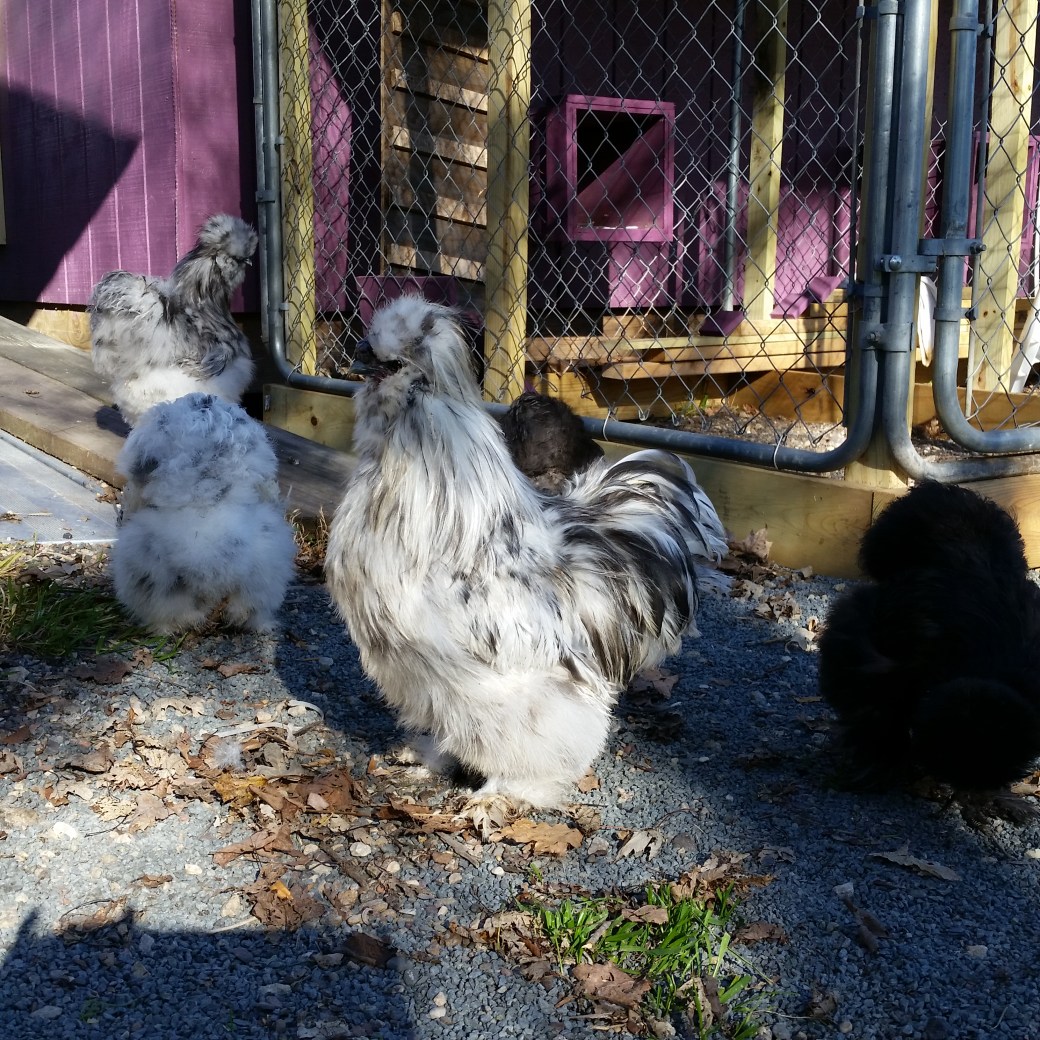
Roosters will try to lure and entice their mates by displaying their beauty as well.  They attempt to attract their mates as they fan their wings in a romantic manner.   This is called a wing drag or wing flicking.  He will begin to make some croaking sounds as he gets closer to the hen.

The rooster performs a dance, circling the hen with his wing dropped stiffly towards the ground and quivering.  As he circles around her making his croaking noise, she will either encourage him or try to come up with an escape plan. In a perfect situation the hen will daintily squat down and raise her shoulders to flatten out, welcoming him in every way.

The rooster then leaps onto her back and balances precariously with one foot on either side of her shoulders.  This is called Threading.  He grabs the female’s neck with his beak and pulls back her head. He then lowers his vent opening (cloaca) by sliding his tail under the hen and she pushes her vent opening to meet with his.  There is no penetration.  The sperm released from the male is taken into the vent by the female.  From there the sperm travels up the oviduct where it awaits the release of an ovum.  The sperm can be actively alive in the hen for more than two weeks. This whole sexual act takes about two seconds.  When mating is done, the hen will rise, shake her feathers and go on with whatever she was doing beforehand.

The female chicken does not have a separate vaginal structure.  The vent or cloaca is used for both defecation and reproduction.  The males also have a vent or cloaca but they do not have a penis to actually penetrate the hen.  The rooster’s sexual organ is called the papilla. It is located inside of the bird, just inside of the vent.  It looks like a small bump.  Semen exits through it.  Ducks have a penis but chickens do not.

A hen lays an egg every day or so regardless if there is a rooster around or not.  In order for it to be a fertile egg, you will need the rooster to do his part.  Each time a yolk ripens, the sperm will fertilize it provided it is in the hen’s oviduct.   The white is created and then lastly the shell will form around the egg.  A fertilized egg will have a dot surrounded by a ring around it which looks like a bullseye on the yolk. In an infertile egg there will only be a white dot.  You can check this out by cracking open an egg and looking at it.

Chickens also engage in a little dance called “tid-bitting.”  If a rooster finds a choice bit of food that looks really tasty, he bobs his head up and down and makes his “tid-bitting” call.  He picks up the food and drops it repeatedly in order to attract the hen.  He may even offer the morsel in his beak.  It all looks very romantic and sweet but he is also establishing his role among the hens as a provider and leader.

There are many different recommendations as to how many hens per rooster to give you adequate fertility in your eggs.  Most say eight to twelve hens per rooster. If you have a heavier breed, the ratio would be lower. If you have a smaller breed the ratio would be higher.  If you would like more information on how to improve fertility in roosters check out this article.

You may want to isolate breeders to make sure that you know who the father is. Wait at least two weeks if your hen has been exposed to other roosters to make sure that all of the sperm inside the hen is no longer active.  If you are interested in showing poultry or are just interested in improving your flock you can set up breeding pens where you can isolate certain pairings in order to get certain types of chicks.

As winter ends and spring begins the testosterone in the roosters starts to rise.  Roosters will begin to mount challenges to each other as they fight for the rights to the hens.  You may want to separate the roosters, but remember, once you separate them it will be very hard to put them back together again.

Crowing is both an invitation to hens and a warning to other roosters in the area.  Serious fights can happen between roosters. They can use their sharp spurs as weapons.  Aggression when establishing dominance is normal behavior in the chicken world.  If you give them plenty of space, they will usually work the dominance hierarchy out themselves.  Chickens have strict pecking orders. The alpha rooster is at the top, then the hens and lastly the younger pullets and cockerels.

A rooster can mate up to thirty times a day depending on how many hens are available to him.  Not all roosters are interested in mating or are built for it.  You should have a similar sized rooster matched with a similar sized hen for best chance of fertilization. If you want to try and improve the virility of your rooster, you may want to add some vitamins and electrolytes to his water or some Rooster Booster Poultry Cell. A little B-12 would perk him up a little too.

Most roosters are very interested in mating with the hens. They will chase hens causing them to lose feathers. Constant harassment on the part of the rooster can cause bald spots on the hen’s back. The roosters do have favorite hens which they will mate repeatedly.  You may want to invest in hen saddles.  They protect the hen’s back and sides.  They can also be worn to prevent self-picking or feather picking from other hens.  Pick no more and Blu-Kote are also products that can help prevent the picking and aid in treatment . Vetericyn Spray will help to treat wounded birds as well.

If you want to aid in feather grow back, Feather Fixer feed can help increase protein in their diet. You may also want to trim the spurs and toenails on your rooster using a diagonal wire cutter.   Information on how to do this is Here.  This can help to prevent any wounds occurring on your hens.

A well mannered rooster who dances for his ladies and waits for them to accept him is a joy to behold. Your pens will be much calmer if you keep and breed roosters with this special ability.

For tips and tricks for raising outstanding silkies check out our Chicken Learning Center at VJPPoultry.com .  VJP Poultry is an NPIP and state inspected hatchery located 30 miles north of St. Paul.  We hatch out silkies all year long so we always have stock available.  Like us on Facebook to get weekly updates on what we currently have for sale.

Victoria J. Peterson

20161105_140436