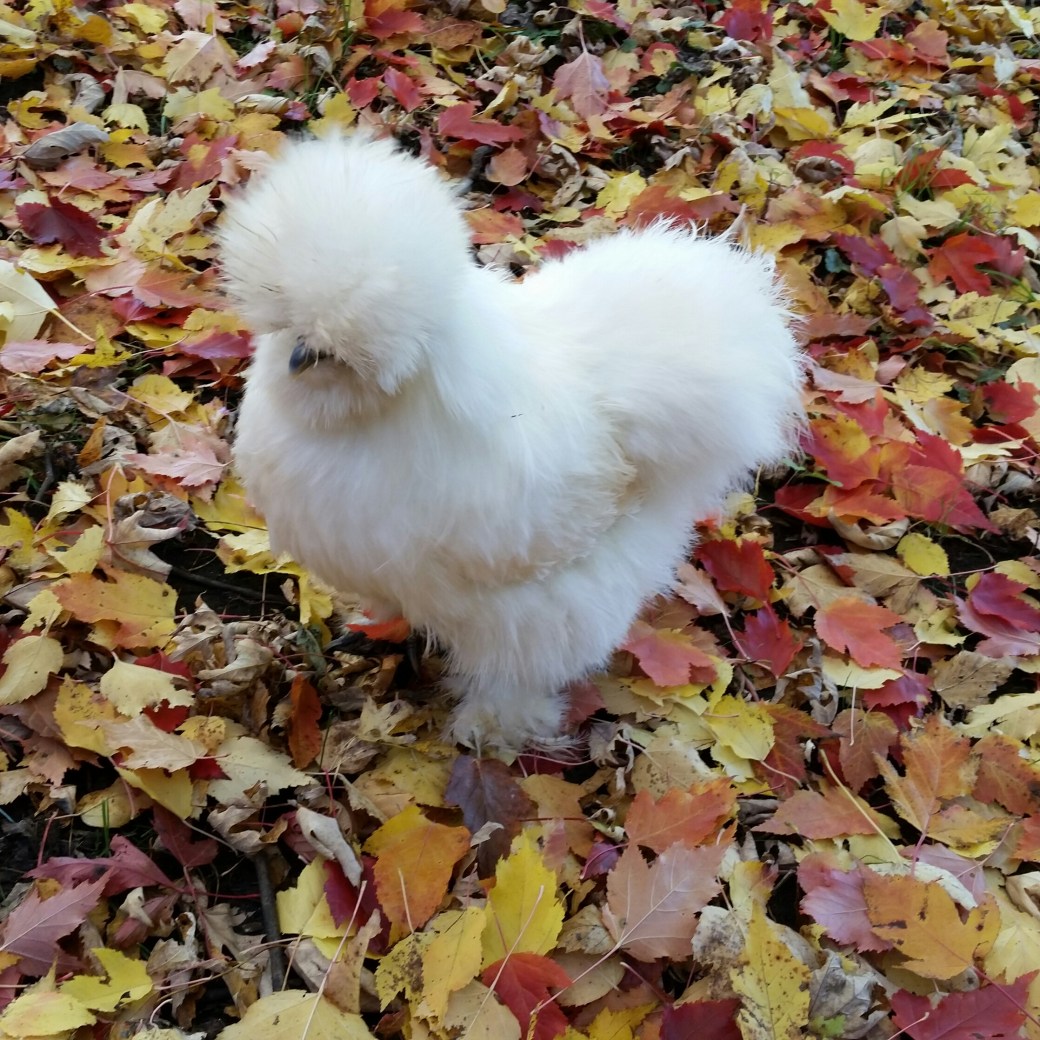
A Look at the Silkie Standard of Perfection

20171020_121935-1The American Standard of Perfection is a wonderful book published by the American Poultry Association. In it you will find all kinds of valuable information on all of the breeds of chickens that are recognized by this group.  Their main purpose is to list characteristics of each breed at their highest level.  This information is used by judges to help them judge the qualities of individual birds against what has been decided as the “perfect” bird of that breed and variety by the American Poultry Association. It is also used by breeders to improve their birds through breeding towards the standard and by exhibitors who want to place well in poultry shows who use the standard as a guide for choosing birds.

In judging, there is a scale of points that equals 100.  Points are assigned to different attributes of the bird.  Points will be deducted if the bird does not meet the standard given.  There are also disqualifications that can be given which will eliminate a bird from competition.  Since silkies  have crests and beards their point system is adjusted to include points for those areas.

The disqualifications specifically for silkies include :  Bright red comb, face and wattles.  Shanks not feathered down outer sides.  Feathers not truly silky (except in primaries, secondaries, leg, toe and main tail feathers.) Vulture hocks. There are other disqualifications that are for all birds, not just silkies.  You would find those under “General Disqualifications” elsewhere in the book.

The standard weight for a silkie cock is 36 oz.  The standard weight for a silkie hen is 32 oz.  The standard weight for a silkie cockerel is 32 oz.  The standard weight for a silkie pullet is 28 oz.

The standard then lists descriptions of each of the areas of the silkie’s appearance.  This is all part of the bird’s shape.  It is best to obtain a copy of the standard so that you can read in detail what the standard entails. I will mention a few of the items of interest but there is much more information listed in the book. I will be discussing the Bearded Silkie only.

The comb should be walnut shaped. In the males it should be circular shaped and have a horizontal indentation across the middle of it. Females should also be walnut and smaller. The wattles should be small and concealed by the beard in bearded silkie males.  The females should be very small and concealed.

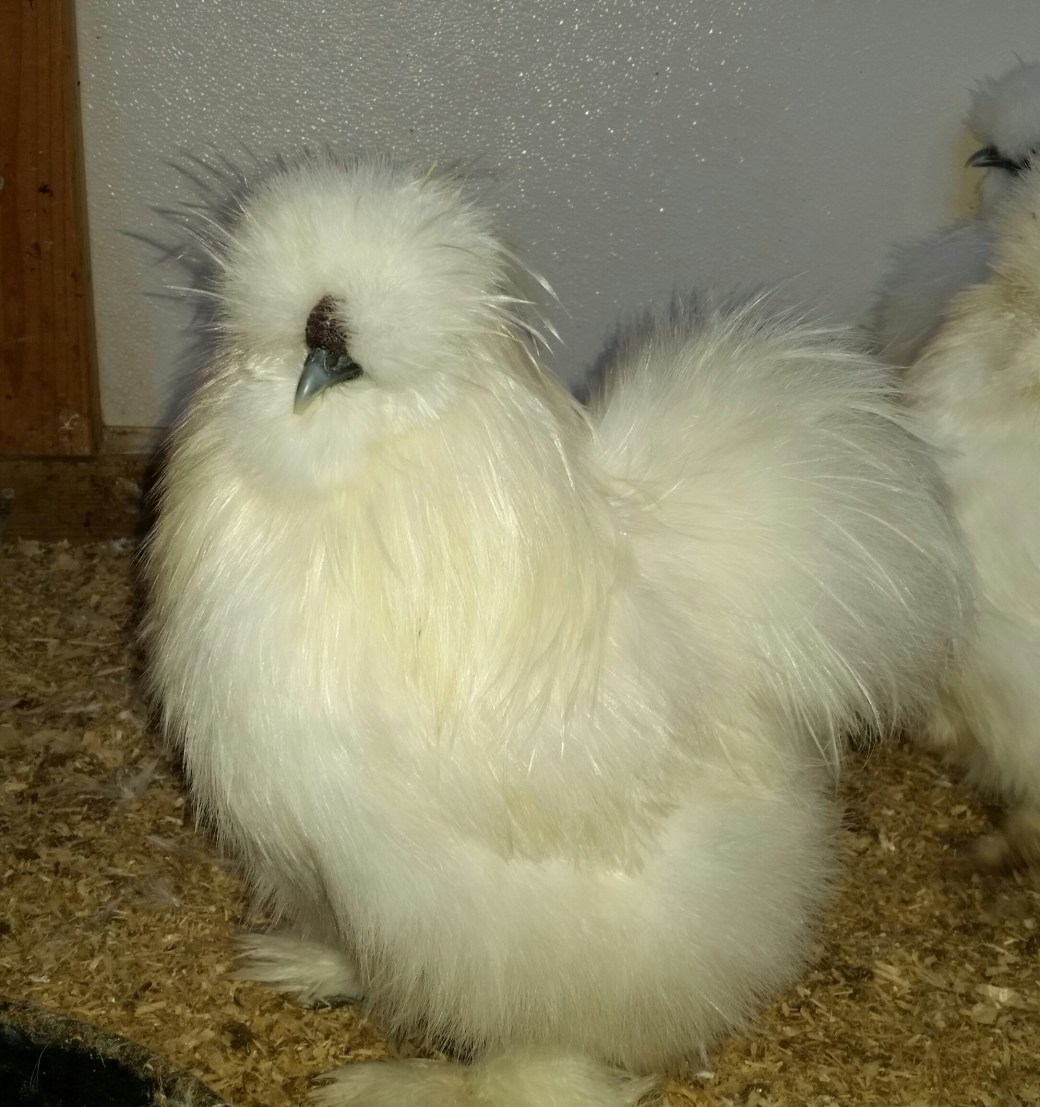
The crest should be medium sized. The beard and muffs should be thick and full. The neck should be short and gracefully curved.  The back should be short and broad and rising back in a curve towards the tail.  The cushion of the tail should be broad and round and very fluffy.  The tail should be  shredded at the ends.

The wings should be closely folded and carried well back being nearly horizontal.  Primaries should be concealed  by secondaries.  The tips should be well shredded with tips being concealed by saddle feathers.

The silkie needs to have five toes. Three in the front and two in the back.  One toe in the natural position and the other placed above it curving upwards and backwards.  Feathering should be to the middle toe.

Comb should be deep mulberry colored.  Beak should be slaty blue and eyes should be black.  Earlobes should be turquoise blue. Skin should be dark blue and toes slaty blue.

Silkie’s feathers come in different colors and not all colors are recognized by the APA. Here are the ones that are recognized: white, black, blue, partridge, buff, gray, splash, self-blue (lavender) and paint.  There are separate descriptions for each of the different color varieties indicating what is accepted and what is not.

Symmetry, as well as, condition and vigor are also important in judging.  The overall shape and balance of the bird is important.  The silkie should look like a “S” curve with the bottom part of the “s” continuing upward.  They almost look completely circular, like a bowling ball when they stand correctly.

There is much more to the silkie standard than I have talked about in this article.  If you would like to purchase a copy, you can get one through the American Poultry Association here.

There are also old copies and  knockoff copies at Amazon that are not printed through the APA.  I think that they are basically  xerox copies and have the same information.

Hopefully this will answer some of your questions concerning what the standard of perfection is.  As a breeder, we are constantly trying to improve our silkies and have them come as close as possible to the standard that has been set. It is important to show your birds as a breeder or attend shows so that you can talk with judges and other people who are knowledgeable about silkies.

For tips and tricks for raising outstanding silkies check out our Chicken Learning Center at VJPPoultry.com .  VJP Poultry is an NPIP and state inspected hatchery located 30 miles north of St. Paul.  We hatch out silkies all year long so we always have stock available.  Like us on Facebook to get weekly updates on what we currently have for sale.

Victoria J. Peterson

Information for this article was taken from The American Standard of Perfection 2010 published by American Poultry Association, Inc.
20171126_125635-1


Why Your Chicken Needs a Dust Bath

20180323_145950-1   All chickens should have access to dust baths.  It doesn’t matter what breed or age of chicken, it is instinctual for them to wallow in the dust and dirt.  It is their way of getting clean and practicing good hygiene.
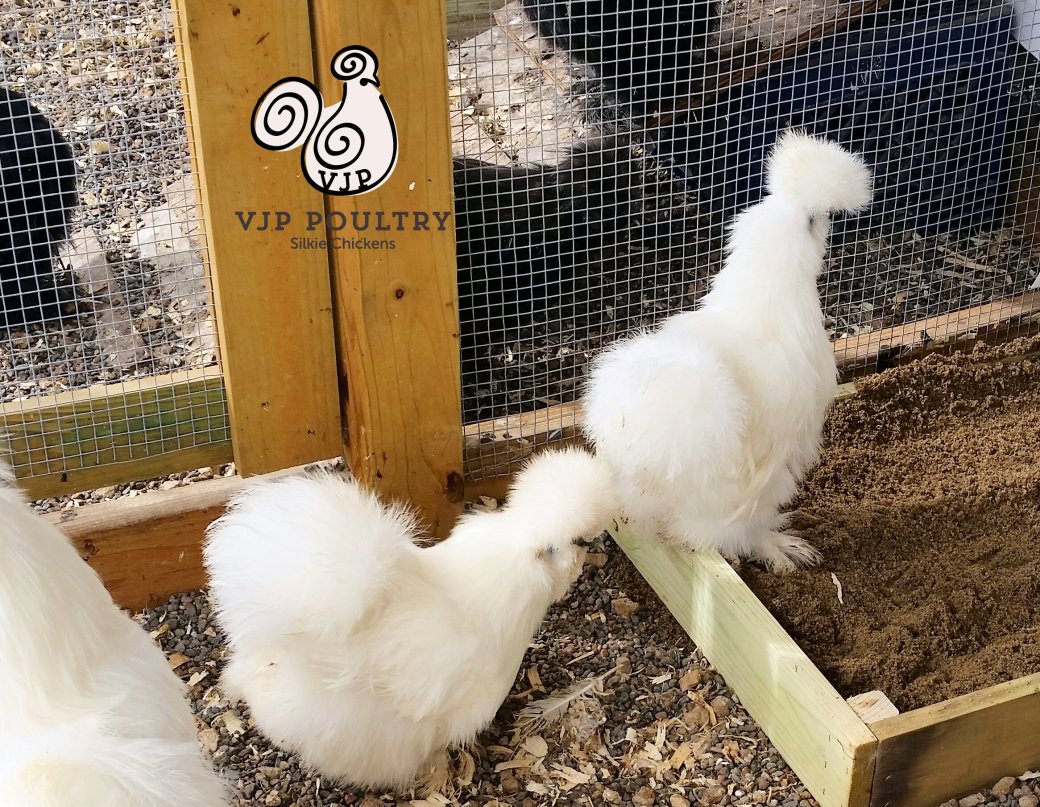
When you first witness this dust bathing, you may think that something is wrong with your bird.  It almost looks like they are in trouble or having a seizure.  They are lying on their sides with one leg sticking out and the other scraping dirt and dust in kind of a circular motion.  The wings are throwing dirt up into the air so that it falls back down on top of them.  It looks scary , but it is perfectly normal.

Chickens will create a dust bath area all by themselves.  A chicken scratches and digs out a bowl shaped depression in the dirt or will even use the shavings inside of the coop.  The chicken settles into this hollow, fluffs up its feathers and then scratches up the dirt.

It might look like they are making a nest to lay eggs because it is round in shape but these are preparations for dust bathing.  Chickens use their feet and wings to get loose dirt throughout their skin and feathers.  Once they are completely covered in a layer of dirt, the bird will fluff and shake off the substance to evenly distribute it on their bodies.

A chicken’s dust bath helps to remove excess oil, as well as parasites such as lice, mites and ticks.  Dust bathing is an important part of keeping chickens healthy and clean.  It is important that your chicken has access to areas where dust bathing can take place. Most will look for a sunny spot with loose dirt.  Even if they never get to free range, you can set up a dust bath in their coop or pen.

There are four main behaviors when dust bathing: vertical wing-shaking, head rubbing, bill raking and scratching with one leg.  The hen scratches with her feet and beak at the ground.  She then erects her feathers and lies down. They create deep bowls as they wiggle and squirm to get dirt deep under their feathers.  They make happy noises while flipping dirt all over themselves.  The dust collects between the feathers and then is shaken off.  This helps to give the feathers good insulating abilities.

Chickens clean their feathers and skin by preening with their beaks and using an oil gland at the base of their tail. After a dust bath a hen will spend time primping and pecking at their feathers. This helps to smooth their feathers and removes sheaths on new feathers.  Feather maintenance is very important.  Birds of all kinds take dust baths and certain mammals do as well to keep clean and remove parasites.

Most dust bathing occurs in the middle of the day. Warm temperatures increase dust bathing behavior. Hens will tend to dust bath if they see other hens doing it.  It ends up being a very social activity.  It is not just hens that will dust bath, but roosters enjoy doing it as well.

The need for a dust bath is ingrained in their behavior.  They will dig holes if you don’t provide them with a spot.  Free ranging birds will find a place in your garden if you let them.   Battery hens in cages will sham dust bathe.  They will go through the motions of dust bathing even if there is no other material in their cages.

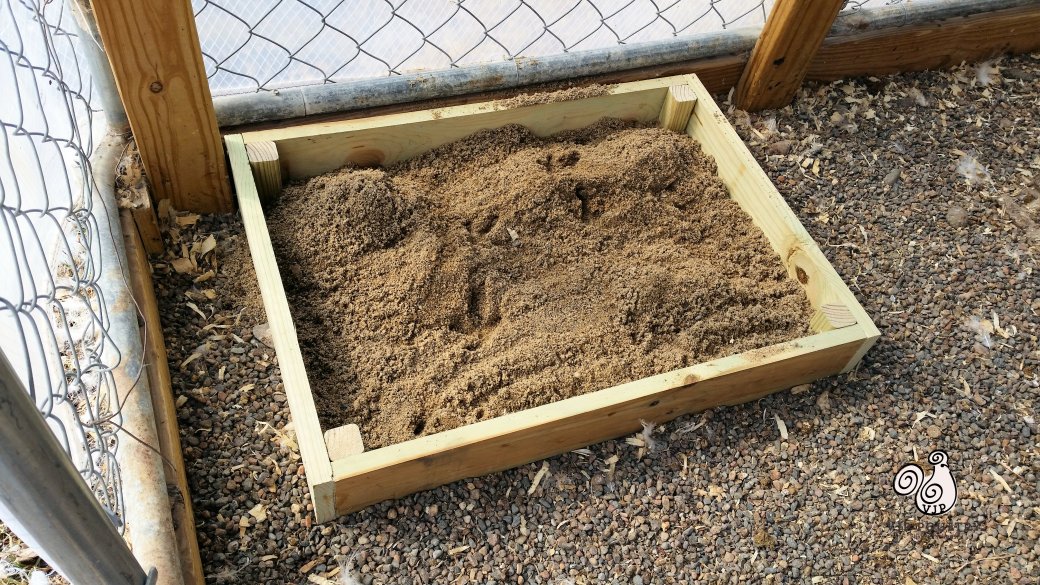
Here at VJP Poultry, we decided it was time to create some dust bathing areas inside of our runs.  We used treated 1″ X 4″ lumber and made 18″ X 24″ boxes with no bottom.  We set them in the run and filled them half full with play sand.

There are other things that you can use to create your dust bathing areas. Any large shallow pan such as a kitty litter pan or small kiddie pools.   Fill it with a variety of substrates.  Some examples would be :  Fine sand, dry dirt,  or peat moss.

Some people like to add food grade diatomaceous Earth or DE.  The sharp edges pierce the soft body parts of parasites and kills them.  Be careful with DE as it can be very harmful if inhaled and can damage lungs.  Use a small amount as part of your substrate.

Firepit ash or ash from a wood stove is another product that can be used. Birds can absorb magnesium, calcium and vitamin K from the ash.  Use ash from hardwood trees and make sure that if you remove it from your own fire pit that there isn’t any additional chemicals such as in treated lumber.

Dried herbs are natural pest repellents.  They can get rid of mosquitoes, flies and ants as well as parasites such as mites, lice and ticks.  They provide calming aroma therapy and have antibacterial properties to heal minor scratches and wounds.  Add them to the substrate as well.

You can also purchase ready made dust bath products.  It is easy to add to what ever other products you want in your dust bath mix.

Remember that you will need to periodically clean out your dust bath area.  I pick out the big chunks daily and give it a good raking.  A cover or a beach umbrella will help to keep out the rain.  You want your dust bath to stay as dry as possible.  One of those turtle sand boxes with a cover or any sandbox with a cover can make a great dusting area.  If possible, move your dusting area inside in the winter to prevent the substrate from freezing.

For tips and tricks for raising outstanding silkies check out our Chicken Learning Center at VJPPoultry.com .  VJP Poultry is an NPIP and state inspected hatchery located 30 miles north of St. Paul.  We hatch out silkies all year long so we always have stock available.  Like us on Facebook to get weekly updates on what we currently have for sale.

Victoria J. Peterson

20180322_144429

My Experience With VJP Poultry from Cage-Free Mom

20180206_141456-1When we decided to get chickens, we knew we wanted them as pets and not for meat production. That led us down a rabbit hole of research and getting opinions from people we trusted. We decided that we were going to get some Silkie chickens. They are known for being friendly , beautiful, small and easy as well as having fairly good egg production (3 per week). Everything we wanted in our first batch of chickens.
A friend of mine referred us to VJP Poultry in Forest Lake, Minnesota. One of her friends had some show chickens from VJP that had done very well in the 4-H program. We were relieved to find someone near us that had quality chickens. They are NPIP tested and hold a State of Minnesota Hatchery Permit. We felt confident that we could get some great chicks from here.

At that point I still wanted to do some more research on how to care for our new chickens and how to sex them so we wouldn’t end up with all roosters! The internet gave me a bunch of mixed information (turns out it is nearly impossible to sex Silkie chicks) so I decided to reach out to VJP Poultry and see if they could give me any nuggets of information! The response time was very fast and they were very patient with all of my questions. I was relieved that they have a rooster return program. I was really nervous about this because in our area, we are not allowed to have roosters. If we do end up with any roosters we can return them to VJP and they will re-home them. Every question was answered and we were welcomed to come out and see their options.They do post weekly on their Facebook Page VJP Poultry Facebook which is very helpful. You can see what colors and ages are available as well as the pricing of them.

Not only do they have great customer service but they also run blog posts on their website. They have links to items you can purchase for your chicks/chickens , articles on ventilation and how to keep your Silkies safe and happy during the winter.

We set a date and went out to see the chicks. Victoria (owner) met us and gave us some time in the chick room. It was nice to have some time to check all the chicks out and discuss our options without feeling the pressure of picking right away. When she came in, she was able to guide us in the right direction. We really wanted a few splash chicks so she went upstairs and brought down some 4 day old babies. We fell in love and decided to take them.

Along with the chicks, she provided us with some bedding and a little sheet giving us tips on how to care for young chicks as well as a copy of their certification.  We were very pleased with our experience and will be returning for all of our future Silkie purchases! I highly recommend them and if you are anywhere in MN or surrounding states, go check them out as they do not ship. Tell them Ashley with Cage-Free Mom sent you!

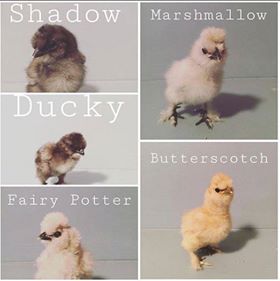
Stay tuned for pictures of our new chicks! (Shadow, Ducky, Butterscotch, Marshmallow & Fairy Potter)

You can find more blogs from Cage-Free Mom here.   Text and lower picture by Ashley Molin – The Cage-Free Mom

For tips and tricks for raising outstanding silkies check out our Chicken Learning Center at VJPPoultry.com .  VJP Poultry is an NPIP and state inspected hatchery located 30 miles north of St. Paul.  We hatch out silkies all year long so we always have stock available.  Like us on Facebook to get weekly updates on what we currently have for sale.

Victoria J. Peterson

27849186_860120317525318_1757353654_n