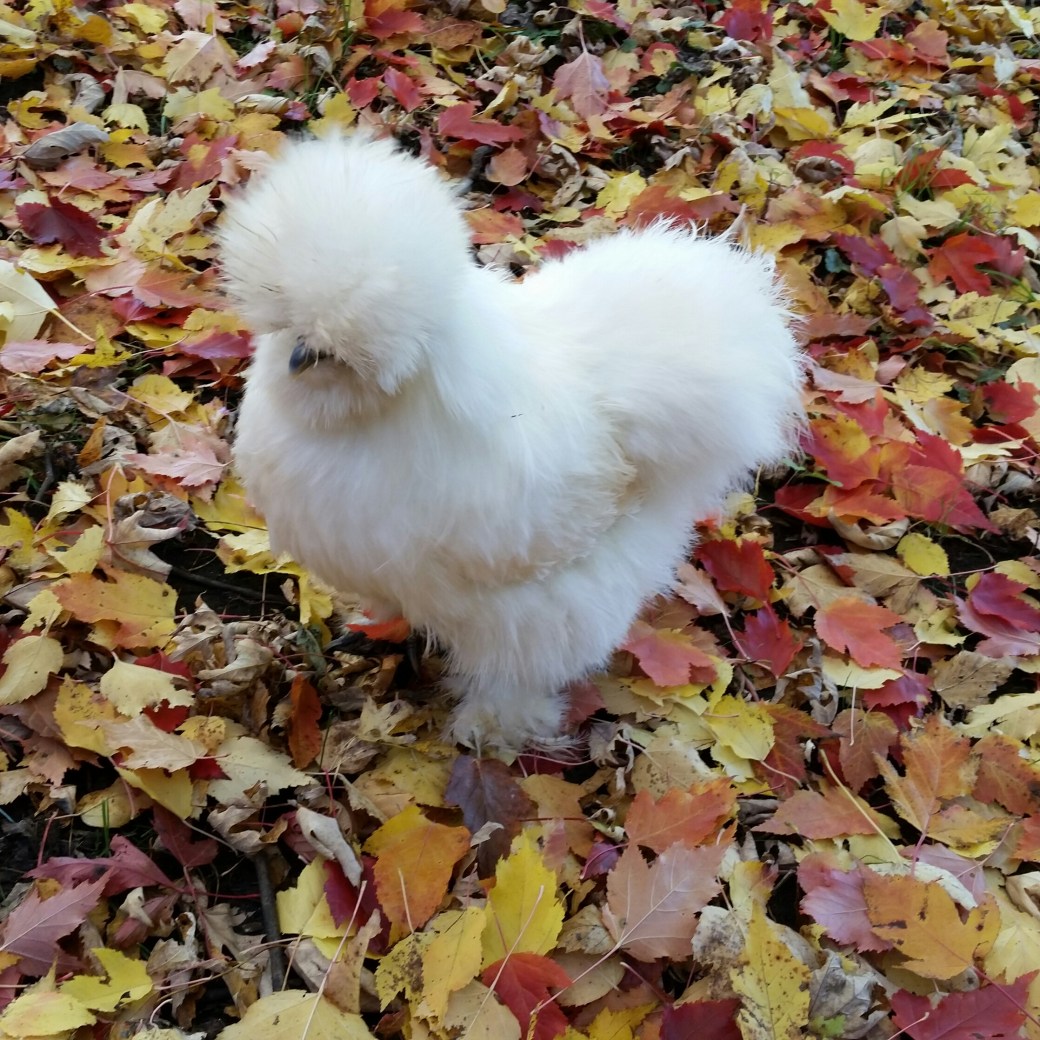
A Look at the Silkie Standard of Perfection

20171020_121935-1The American Standard of Perfection is a wonderful book published by the American Poultry Association. In it you will find all kinds of valuable information on all of the breeds of chickens that are recognized by this group.  Their main purpose is to list characteristics of each breed at their highest level.  This information is used by judges to help them judge the qualities of individual birds against what has been decided as the “perfect” bird of that breed and variety by the American Poultry Association. It is also used by breeders to improve their birds through breeding towards the standard and by exhibitors who want to place well in poultry shows who use the standard as a guide for choosing birds.

In judging, there is a scale of points that equals 100.  Points are assigned to different attributes of the bird.  Points will be deducted if the bird does not meet the standard given.  There are also disqualifications that can be given which will eliminate a bird from competition.  Since silkies  have crests and beards their point system is adjusted to include points for those areas.

The disqualifications specifically for silkies include :  Bright red comb, face and wattles.  Shanks not feathered down outer sides.  Feathers not truly silky (except in primaries, secondaries, leg, toe and main tail feathers.) Vulture hocks. There are other disqualifications that are for all birds, not just silkies.  You would find those under “General Disqualifications” elsewhere in the book.

The standard weight for a silkie cock is 36 oz.  The standard weight for a silkie hen is 32 oz.  The standard weight for a silkie cockerel is 32 oz.  The standard weight for a silkie pullet is 28 oz.

The standard then lists descriptions of each of the areas of the silkie’s appearance.  This is all part of the bird’s shape.  It is best to obtain a copy of the standard so that you can read in detail what the standard entails. I will mention a few of the items of interest but there is much more information listed in the book. I will be discussing the Bearded Silkie only.

The comb should be walnut shaped. In the males it should be circular shaped and have a horizontal indentation across the middle of it. Females should also be walnut and smaller. The wattles should be small and concealed by the beard in bearded silkie males.  The females should be very small and concealed.

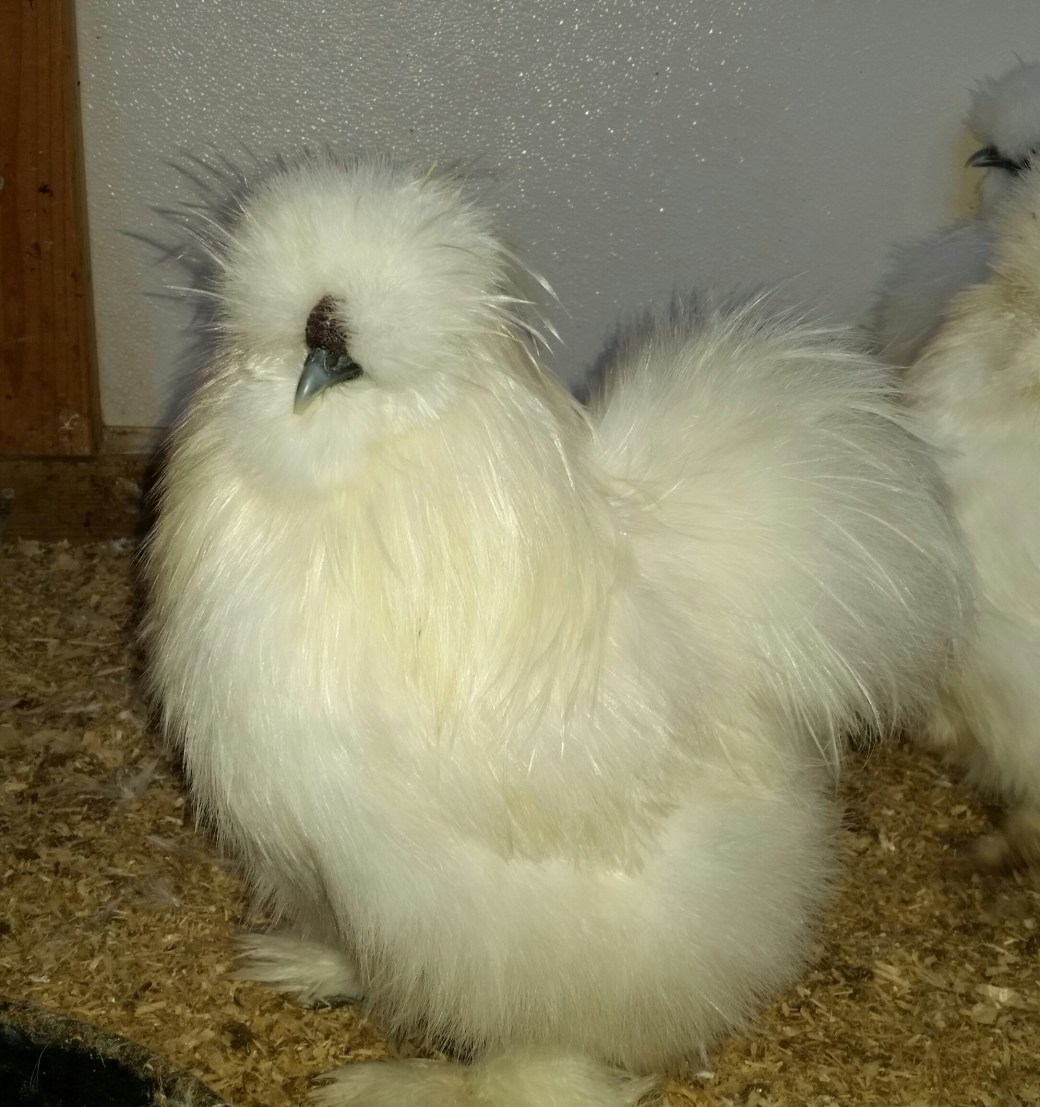
The crest should be medium sized. The beard and muffs should be thick and full. The neck should be short and gracefully curved.  The back should be short and broad and rising back in a curve towards the tail.  The cushion of the tail should be broad and round and very fluffy.  The tail should be  shredded at the ends.

The wings should be closely folded and carried well back being nearly horizontal.  Primaries should be concealed  by secondaries.  The tips should be well shredded with tips being concealed by saddle feathers.

The silkie needs to have five toes. Three in the front and two in the back.  One toe in the natural position and the other placed above it curving upwards and backwards.  Feathering should be to the middle toe.

Comb should be deep mulberry colored.  Beak should be slaty blue and eyes should be black.  Earlobes should be turquoise blue. Skin should be dark blue and toes slaty blue.

Silkie’s feathers come in different colors and not all colors are recognized by the APA. Here are the ones that are recognized: white, black, blue, partridge, buff, gray, splash, self-blue (lavender) and paint.  There are separate descriptions for each of the different color varieties indicating what is accepted and what is not.

Symmetry, as well as, condition and vigor are also important in judging.  The overall shape and balance of the bird is important.  The silkie should look like a “S” curve with the bottom part of the “s” continuing upward.  They almost look completely circular, like a bowling ball when they stand correctly.

There is much more to the silkie standard than I have talked about in this article.  If you would like to purchase a copy, you can get one through the American Poultry Association here.

There are also old copies and  knockoff copies at Amazon that are not printed through the APA.  I think that they are basically  xerox copies and have the same information.

Hopefully this will answer some of your questions concerning what the standard of perfection is.  As a breeder, we are constantly trying to improve our silkies and have them come as close as possible to the standard that has been set. It is important to show your birds as a breeder or attend shows so that you can talk with judges and other people who are knowledgeable about silkies.

For tips and tricks for raising outstanding silkies check out our Chicken Learning Center at VJPPoultry.com .  VJP Poultry is an NPIP and state inspected hatchery located 30 miles north of St. Paul.  We hatch out silkies all year long so we always have stock available.  Like us on Facebook to get weekly updates on what we currently have for sale.

Victoria J. Peterson

Information for this article was taken from The American Standard of Perfection 2010 published by American Poultry Association, Inc.
20171126_125635-1


How To Integrate New Chickens Into Your Flock

20161106_123815Chicken Math is a very real thing.  We enjoy adopting new members to our flock and we want it to go as smoothly as possible.  Every year new birds are added and older birds are replaced or die off naturally.  A hen may chose to raise a clutch of chicks or new breeds catch our eye and we then must figure a way to incorporate these new birds into the standing social order.
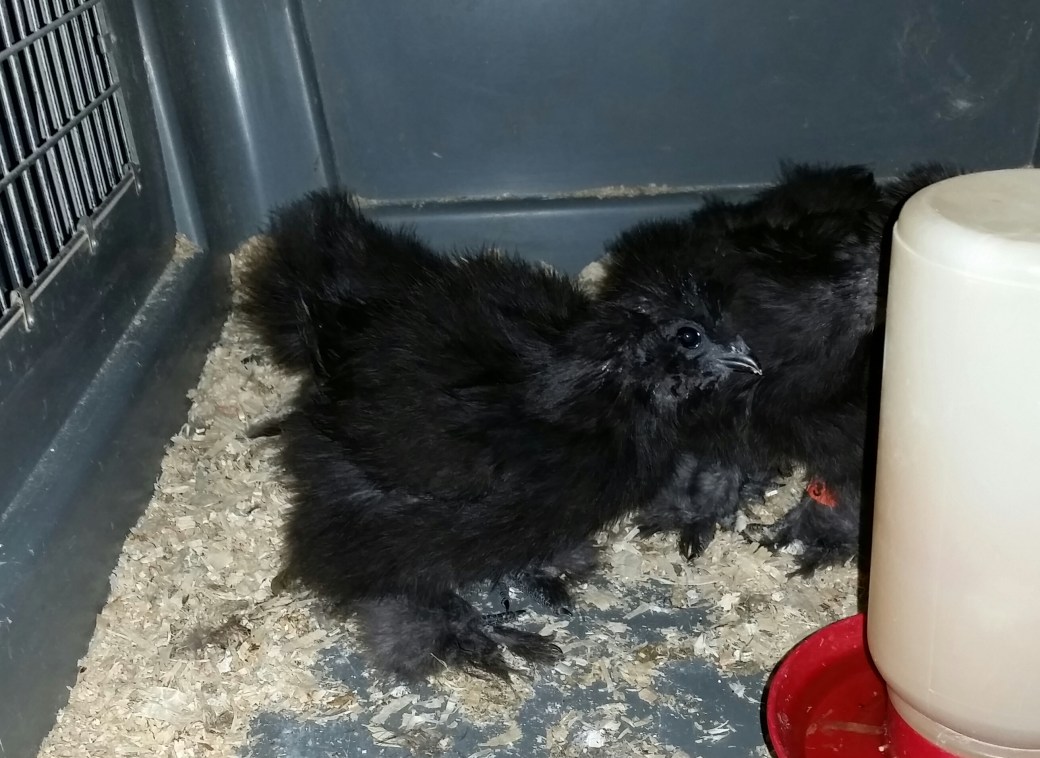
Chickens are very social animals.  There is an order of dominance or what is called a “pecking order.”  The correct  integration of new birds is important.  You need to manage the pecking order so that new birds and chicks do not get hurt and the original flock does not become overly stressed.

When you first acquire new adult birds, they will need to be quarantined before you can mix them in with your home flock.  This is for the safety of your flock.  Do not quarantine them in the same area as your current birds.  Have a separate pen or crate away from the others.  They will need a place they can stay for thirty days.  You do not need to quarantine chicks that you buy from a hatchery as these are not exposed to an adult flock that may contain germs.

Each flock of chickens has their own germs that make them immune to certain things in their environment.  A new bird will not have that immunity.  This would  be a good time to give it some probiotics or Rooster Booster to help supplement its immune system.  A feed with extra protein will help it deal with the stress of being in a new place.

The new adult bird may also have some hidden issues.  Check for lice, mites, breathing problems or discharge from the eyes or nostrils.  A little poultry dust in case of mites or apple cider vinegar in the water for general health wouldn’t hurt.  Disease can take up to a month to show itself in a healthy bird.  Make sure that you practice biosecurity  and wash your hands when handling new birds.

It is best to introduce new birds in pairs or more. Do not buy a single bird and expect it to smoothly be accepted by the others.  Being alone and new is a double disadvantage.  If there is more than one bird introduced at the same time , they will then have a buddy to hang out with.  There is also more than one bird to take all of the pecks that will be directed their way.

Always add birds of a similar size to the flock. Larger breeds are always more dominant and will bully the smaller breeds. If you have a flock of Jersey Giants it would be difficult for a small bantam to be accepted.  Try to wait as long as possible to introduce young birds.  They should be done making baby noises and be as fully feathered out as possible.

The first step is to separate them in the coops and outside runs.  The idea is to keep them separate but visible to each other.  Seeing but no touching each other. They may try to fight through the fence but they can’t hurt each other.  Poultry netting is a good way to separate them.  Even just a dog crate sitting in the run will work.  Do this for a few days to a week.

When it is time to actually put the birds together there is a few ways you can do it.  Some people think that the best time to do it is at night after they have gone to bed.  Stick the new ones on the roost and they will all wake up together the next morning and may be more accepting.

Another method is to do a free range situation.  Let the new birds out to free range first.  Then let the rest of the flock out.  There is plenty of room for the new birds to run and hide or just plain get away from any unwanted pecks.

If you don’t let your birds free range, you can put the new birds in the run first and then let the older flock out. By letting the new birds out first, they can find out where the food and water is first. Distract the flock with treats so they won’t be so focused on the new chickens.  Make sure that you have multiple feeding dishes and watering stations.  The older flock may try and block the new birds from eating and drinking.

Make sure that they have plenty of room.  Overcrowding will stress everyone out and make the older birds resentful.  Put out more food and treats than they actually need.  Flock blocks can be helpful.  Hiding places are also important.  Just placing a piece of wood against a wall can provide a hiding place for a scared bird.

I know that it is hard, but the less interference from humans the better.  Unless there is blood it is best to let them work it out themselves.  If a bird is super aggressive towards a new one, put it in a dog kennel for a few days.  When it comes out, it will become a “new” bird and be taken down a peg or two.

Two or more roosters will not get along unless they are raised together and are not where they can see hens.  Ten hens per rooster is the recommended amount.  Don’t introduce a new adult rooster to a flock that already has a rooster. They will fight for dominance.

After you have introduced new birds, watch to make sure that they are eating and drinking.  Give them plenty of places to hide behind.  Put everyone on the same food and have separate dishes of oyster shell.

The introduction of new birds can cause your old flock to stop egg production for awhile until things settle down.  It will take a few weeks but soon everyone will have a new place in the pecking order.

For tips and tricks for raising outstanding silkies check out our Chicken Learning Center at VJPPoultry.com .  VJP Poultry is an NPIP and state inspected hatchery located 30 miles north of St. Paul.  We hatch out silkies all year long so we always have stock available.  Like us on Facebook to get weekly updates on what we currently have for sale.

Victoria J. Peterson

20180413_125506-1

The Mysterious Courtship Dance of Chickens

20161105_140426Most birds perform some kind of courtship dance as a prelude to actual mating. There are many magnificent displays in the avian world. Think about what peacocks do in their foreplay to get the lady bird in the mood with their beautiful tails.
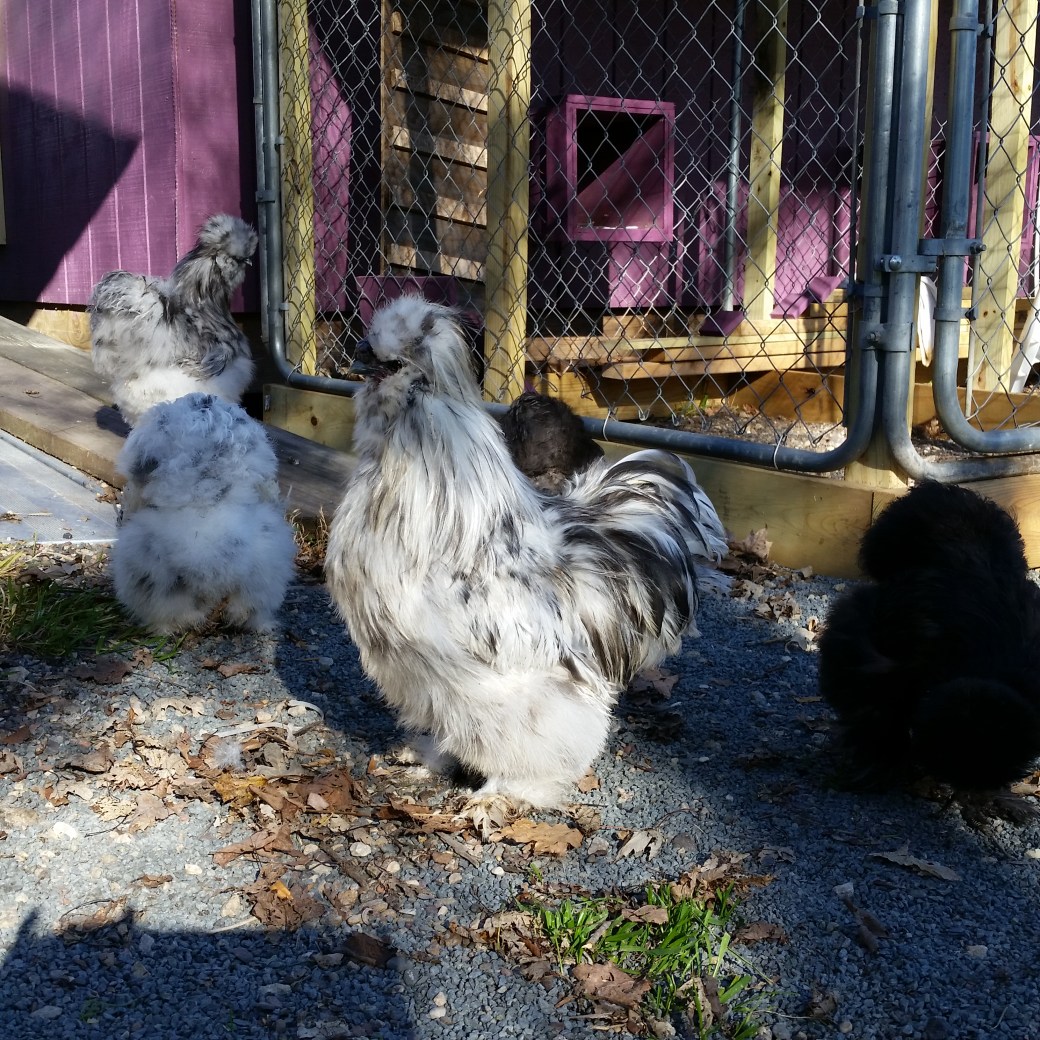
Roosters will try to lure and entice their mates by displaying their beauty as well.  They attempt to attract their mates as they fan their wings in a romantic manner.   This is called a wing drag or wing flicking.  He will begin to make some croaking sounds as he gets closer to the hen.

The rooster performs a dance, circling the hen with his wing dropped stiffly towards the ground and quivering.  As he circles around her making his croaking noise, she will either encourage him or try to come up with an escape plan. In a perfect situation the hen will daintily squat down and raise her shoulders to flatten out, welcoming him in every way.

The rooster then leaps onto her back and balances precariously with one foot on either side of her shoulders.  This is called Threading.  He grabs the female’s neck with his beak and pulls back her head. He then lowers his vent opening (cloaca) by sliding his tail under the hen and she pushes her vent opening to meet with his.  There is no penetration.  The sperm released from the male is taken into the vent by the female.  From there the sperm travels up the oviduct where it awaits the release of an ovum.  The sperm can be actively alive in the hen for more than two weeks. This whole sexual act takes about two seconds.  When mating is done, the hen will rise, shake her feathers and go on with whatever she was doing beforehand.

The female chicken does not have a separate vaginal structure.  The vent or cloaca is used for both defecation and reproduction.  The males also have a vent or cloaca but they do not have a penis to actually penetrate the hen.  The rooster’s sexual organ is called the papilla. It is located inside of the bird, just inside of the vent.  It looks like a small bump.  Semen exits through it.  Ducks have a penis but chickens do not.

A hen lays an egg every day or so regardless if there is a rooster around or not.  In order for it to be a fertile egg, you will need the rooster to do his part.  Each time a yolk ripens, the sperm will fertilize it provided it is in the hen’s oviduct.   The white is created and then lastly the shell will form around the egg.  A fertilized egg will have a dot surrounded by a ring around it which looks like a bullseye on the yolk. In an infertile egg there will only be a white dot.  You can check this out by cracking open an egg and looking at it.

Chickens also engage in a little dance called “tid-bitting.”  If a rooster finds a choice bit of food that looks really tasty, he bobs his head up and down and makes his “tid-bitting” call.  He picks up the food and drops it repeatedly in order to attract the hen.  He may even offer the morsel in his beak.  It all looks very romantic and sweet but he is also establishing his role among the hens as a provider and leader.

There are many different recommendations as to how many hens per rooster to give you adequate fertility in your eggs.  Most say eight to twelve hens per rooster. If you have a heavier breed, the ratio would be lower. If you have a smaller breed the ratio would be higher.  If you would like more information on how to improve fertility in roosters check out this article.

You may want to isolate breeders to make sure that you know who the father is. Wait at least two weeks if your hen has been exposed to other roosters to make sure that all of the sperm inside the hen is no longer active.  If you are interested in showing poultry or are just interested in improving your flock you can set up breeding pens where you can isolate certain pairings in order to get certain types of chicks.

As winter ends and spring begins the testosterone in the roosters starts to rise.  Roosters will begin to mount challenges to each other as they fight for the rights to the hens.  You may want to separate the roosters, but remember, once you separate them it will be very hard to put them back together again.

Crowing is both an invitation to hens and a warning to other roosters in the area.  Serious fights can happen between roosters. They can use their sharp spurs as weapons.  Aggression when establishing dominance is normal behavior in the chicken world.  If you give them plenty of space, they will usually work the dominance hierarchy out themselves.  Chickens have strict pecking orders. The alpha rooster is at the top, then the hens and lastly the younger pullets and cockerels.

A rooster can mate up to thirty times a day depending on how many hens are available to him.  Not all roosters are interested in mating or are built for it.  You should have a similar sized rooster matched with a similar sized hen for best chance of fertilization. If you want to try and improve the virility of your rooster, you may want to add some vitamins and electrolytes to his water or some Rooster Booster Poultry Cell. A little B-12 would perk him up a little too.

Most roosters are very interested in mating with the hens. They will chase hens causing them to lose feathers. Constant harassment on the part of the rooster can cause bald spots on the hen’s back. The roosters do have favorite hens which they will mate repeatedly.  You may want to invest in hen saddles.  They protect the hen’s back and sides.  They can also be worn to prevent self-picking or feather picking from other hens.  Pick no more and Blu-Kote are also products that can help prevent the picking and aid in treatment . Vetericyn Spray will help to treat wounded birds as well.

If you want to aid in feather grow back, Feather Fixer feed can help increase protein in their diet. You may also want to trim the spurs and toenails on your rooster using a diagonal wire cutter.   Information on how to do this is Here.  This can help to prevent any wounds occurring on your hens.

A well mannered rooster who dances for his ladies and waits for them to accept him is a joy to behold. Your pens will be much calmer if you keep and breed roosters with this special ability.

For tips and tricks for raising outstanding silkies check out our Chicken Learning Center at VJPPoultry.com .  VJP Poultry is an NPIP and state inspected hatchery located 30 miles north of St. Paul.  We hatch out silkies all year long so we always have stock available.  Like us on Facebook to get weekly updates on what we currently have for sale.

Victoria J. Peterson

20161105_140436

Silkies For Sale – 2/8/18

Feeding Strategies for Silkie Chickens in the Winter

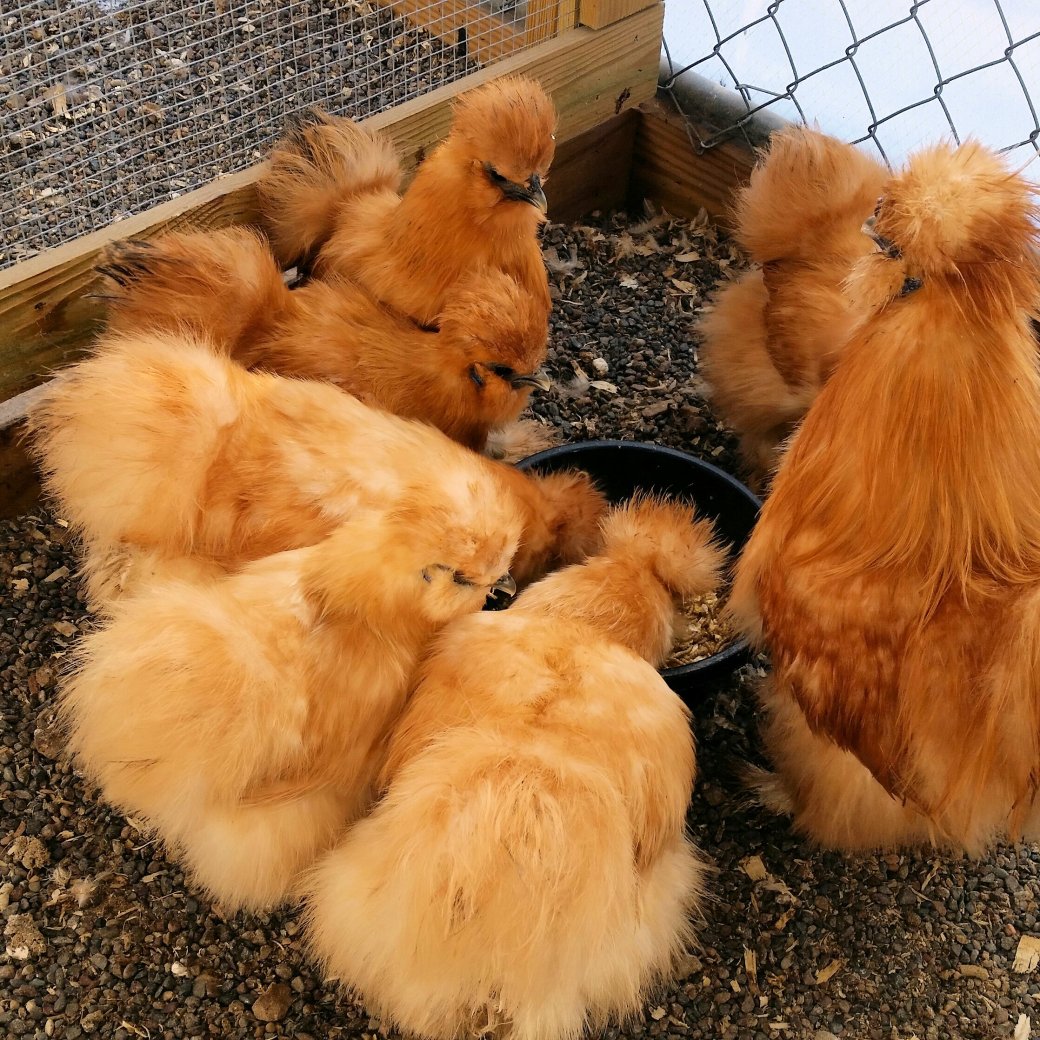
bestFeeding chickens in the winter is a little different than feeding chickens during the rest of the year.  During nice weather, chickens love to forage and free range in the pasture looking for the choicest bits of protein and green roughage.  They are so happy and content and their minds are fully occupied. In the winter, however, there are limited opportunities to free range. They do not like snow and in Minnesota their chance of finding bugs is slim to none.
Hens that are laying eggs need extra protein all year round and its not just the right kind of food but the right amount of food that is important as well.  As winter approaches , a chicken’s feed consumption will be 1.5 times the amount they eat in the spring and summer.  You will notice an increase in your feed bill and you will be filling those feeding dish more often.

This increase in food consumption is due to the fact that they are coming off of their fall molt and need energy to regrow feathers.   They are also using more energy in order to keep warm in the winter.  They can’t just put on another sweater. They have to generate body heat to keep themselves from freezing.  If they were free rangers they no longer have access to free food in the form of bugs and greens.  Instead they will be increasing their feed consumption in their feeding bowls.

The most important thing to remember when feeding in the winter is to  make sure that they are getting plenty of their regular, nutritious feed.  Some people have their hens on layer food which has calcium in it. It is around 16% protein.  I like to feed mine a Gamebird feed which has a higher percent of protein.  I think that silkies benefit all year round from that higher 24% protein. These basic feeds are created to give your bird the correct amount of vitamins and minerals that they need. This is what they should be eating most of the day.  Add Oyster shell to the feed for eggshell development.  I also put vitamins in their water because I think that silkies need that extra amount of nutrients.

Carbohydrate treats help to keep your birds warm especially on exceptionally cold days. The best sources are what you would find in chicken scratch.  Cracked corn, oats and wheat. Scratch scattered around the coop or run will also give the birds something to do and keep them occupied.  Remember to offer grit with the scratch.  In the winter the small rocks in your run may be covered in snow not allowing the chickens to find their own grit.  They need the grit in their crops in order to grind up these scratch grains.

Some people make a nice bowl of warm oatmeal for their chickens on cold mornings. It is a great treat to warm up their insides.  Just use regular breakfast oatmeal but make sure that you are not serving it too hot.  Cracked corn is a wonderful winter treat. I give mine to my silkies right before bedtime. They will go to bed with a full crop and be warm all night. Watch out for cracked corn turning white silkie’s feathers a yellow tinge on their necks and crests. I usually feed oatmeal instead of corn to the whites.  Also, be aware that too many carbohydrates will make your chickens overweight.  A heavy hen is not a good layer so be careful with the amount of treats.  Treats should be given later in the day as the birds need the nutrients from their main feed first.

Sprouting grains and fodder is a great way to bring the goodness of the outdoor summer pasture all year round.  Sprouting grains can increase the enzyme, vitamin and protein content of any seed.  I have sprouted and fed my birds both oats and wheat.  If you would like to learn how to sprout check out “Sprouting Grains and Growing Fodder” in our blog archives.

Live mealworms can be grown at home or ordered as a fun protein treat.  You can grow them using wheat bran as bedding.  If you are not sure that you want to deal with live mealworms, they also have the dried form which the birds also enjoy.  You can also order live crickets which your hens will have no trouble gobbling up.  There are freeze dried crickets as well.

Boredom is common during the winter in the coop.  You don’t want the birds to turn on each other in desperation for something new and interesting to do. Try hanging a cabbage or head of lettuce in one of these treat balls. They will spend hours trying to get at those leafy vegetables.  Be sure and feed extra greens such as kale, collard, chard and spinach.  Leftovers from your salads are great for them as are any kitchen scraps.

Flock Blocks are popular because they lasts a long time.  Chickens have an instinct to peck at things.  Better to have them pecking at a flock block than pecking at each other during the winter months.

If you are offering treats to your flock outside in the winter, make sure that you are placing it in some kind of bowl or feeding dish.  The ground can be very wet outside in the winter.  If you sprinkle food on the ground it will get soggy.  Birds do not like soggy food.  Make sure you clean up any left over food and pellets.  If you don’t it will attract pests such as mice.  Store extra food safely in sealable containers so you don’t attract predators.

For tips and tricks for raising outstanding silkies check out our Chicken Learning Center at VJPPoultry.com .  VJP Poultry is an NPIP and state inspected hatchery located 30 miles north of St. Paul.  We hatch out silkies all year long so we always have stock available.  Like us on Facebook to get weekly updates on what we currently have for sale.

Victoria J. Peterson


20180123_121432